What to do with the stump grindings.
Every stump job ends with a heap of chip and soil that is two to three times the size of the stump it came from. Some of it is genuinely useful, some of it will cost you a lawn if you put it in the wrong place, and sometimes the right answer is to pay to have it gone. Here is the honest version of all three.
The heap is bigger than the stump was.
A ground stump yields roughly two to three times its own volume in material. Two things cause that. The timber comes off as loose chip instead of leaving in one solid piece, so it holds air and takes up more room than the wood ever did standing up. And the cutting wheel takes soil with it, because the outer surface of a stump and the top of its root flare are packed with dirt, grit and small stones that have been washing in around the bark for years.
In practical terms, a 500mm stump ground to 300mm below grade fills three or four wheelbarrow loads. Most people picture a bucket. What they get is a pile that covers about a square metre and stands 300mm high, and it looks like far more than could ever have come out of that hole, because a fair amount of it did not. It came out of the ground around the hole.
That is why the spoil decision belongs in the quote rather than at the end of the job. Where the material goes changes the price, changes the finish, and on a job where turf or a garden bed is coming next it changes whether the result works at all. Full pricing for both options sits on the 2026 price guide.
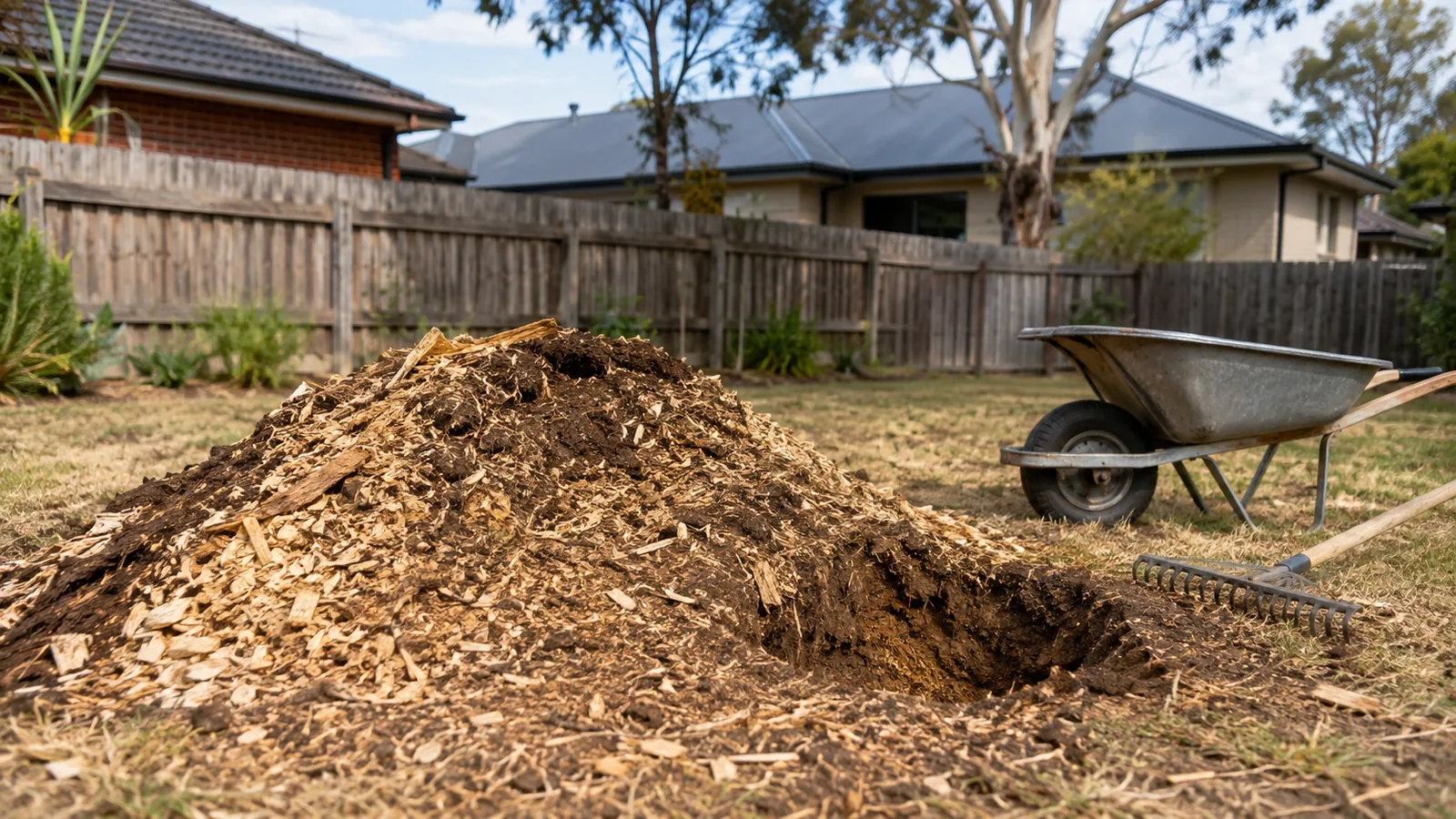
Grindings and arborist mulch are different products.
People use the words interchangeably and then wonder why the material behaves badly in a garden bed. They come off different machines and they contain different things.
| Stump grindings | Arborist mulch | |
|---|---|---|
| Where it comes from | A grinder wheel cutting into ground level and below | A chipper fed with branches and leaf above ground |
| Soil and grit content | High. Dirt, sand and small stones through it | Low to none |
| Particle size | Dust up to 50mm slabs of bark, all mixed | Reasonably even, sized by the chipper |
| Green material | None. Dry heartwood, bark and root | Leaf and fine twig, which supplies nitrogen |
| Disease risk | Whatever killed the tree is in it | Usually from live prunings |
| Sensible use | Path fill, track base, hole backfill, weed suppression on a rough fence line | Garden beds, around plants you care about |
The pathogen point is not scaremongering, it is just a reason to be selective. If a tree came down because it was healthy and in the wrong place, its grindings are inert organic matter. If it came down because it was dying, and particularly if it was a fruit tree or an elm or something with a known root disease, spreading that material through a bed you are about to replant is an avoidable risk. Put it on a path instead.
Why anything planted in fresh grindings struggles.
Fresh grindings are almost entirely carbon. Wood, bark and root have a very high carbon to nitrogen ratio, and the soil microbes that break that material down need nitrogen to do the work. They take it from the soil immediately around them, which is exactly the soil a new lawn or a new shrub is trying to root into. For as long as the breakdown is running hard, your plant and the microbes are drawing on the same limited pool, and the microbes are better at it.
What that looks like in a yard is familiar. Turf laid straight over raked-back grindings goes pale within three to four weeks, thins, and then dips as the material underneath compacts. A replacement tree planted into the same hole it came out of sits there for two seasons putting on almost nothing. Neither is a turf problem or a tree problem. It is a nitrogen problem with a physical settlement problem sitting on top of it.
Adding fertiliser does not really solve it, because you are feeding the breakdown as much as the plant, and you would have to keep doing it for a year or more. The two fixes that work are removing the grindings from the root zone and backfilling with clean topsoil, or leaving the material alone for twelve to twenty four months until the ratio has evened out. If you intend to replant in the same spot, tell whoever grinds the stump, because the depth changes too. That is covered in how deep to grind a stump.
Where grindings actually earn their keep.
Free material with real uses, provided you keep it away from anything that has to grow or anything that has to stay level.
| Use | Verdict | Why |
|---|---|---|
| Filling the hole it came from | Good, with a mound | Free, and the settlement is predictable if you mound rather than level |
| Informal path or track fill | Good | Compacts down, drains, and nothing needs to grow in it |
| Weed suppression on a back fence line | Good | The nitrogen drawdown works in your favour where you want nothing growing |
| Under a trampoline, swing or clothesline | Good | Soft, cheap, and it stops the grass wearing to mud |
| Slow composting in a heap | Reasonable, with patience | 12 to 24 months, turned occasionally, ideally with lawn clippings for nitrogen |
| Mulch around plants you value | Poor | Nitrogen drawdown, uneven size, grit, possible pathogen |
| Anywhere turf is going down | Poor | Yellow patch first, sunken patch second |
| Banked against a house wall or subfloor vent | Avoid | Damp organic matter against a wall is bad practice for several reasons at once |
That last line deserves a sentence of its own. Piling any damp organic material against the base of a house is poor practice whether or not termites are on your mind, because it holds moisture against the wall and can bridge over weep holes, a physical termite barrier or an inspection zone. Spread it at the back of the block instead. The wider question of stumps, decay and pest risk is dealt with honestly on do old stumps attract termites.
Six to eighteen months of sinking, which is why we mound.
Grindings raked back into a hole are loose. Air fills a large share of the volume, and over the following months rain, foot traffic and decomposition drive that air out. The material drops. On the heavy clay across the Pakenham and Officer flats the drop is slower and smaller, because the surrounding ground holds its shape and the grindings do not have far to go. Down through Koo Wee Rup and the drained swamp country, where the ground is peat and sand, backfill slumps noticeably more and keeps moving for longer.
Six to eighteen months is the working range for most Cardinia jobs. That is the reason the standard finish is to rake the grindings back and mound them 50 to 100mm proud of the surrounding ground rather than screeding them flush. A flush finish looks tidier on the day and becomes a shallow dish that collects water by the next winter. A mound looks slightly odd for a fortnight and ends up level.
If you cannot live with a mound, or the spot is in the middle of a lawn you mow every week, the alternative is to take the grindings away and backfill with clean topsoil, which settles far less because it has no air and no decomposition to come. Where paving, turf or a slab is going over the top, the grindings have to come out regardless of how the ground looks, and that sequencing is set out in stump grinding before turf or concrete.
When carting the grindings away is worth $120 to $350.
Removal is priced at roughly $120 to $350 per stump depending on volume and how far the material has to be barrowed to the truck, and clean topsoil backfill on top of that is another $80 to $220. On a $280 stump that can double the invoice, so it is worth being deliberate about.
Pay for removal when something is going on the spot. Turf, a new tree in the same hole, a garden bed you are replanting, pavers, a path, a shed slab or any kind of footing. In all of those cases the grindings are actively in the way, either chemically or because they will settle under whatever you build. On a slab or a footing the answer goes further than spoil removal, because grinding is the wrong method entirely and the root plate needs excavating. That case is set out in stump removal before a shed or extension.
Skip it when the spot is going back to ordinary lawn that you are happy to top-dress and overseed in a year, when the stump is in a garden bed or a back corner nobody inspects, or when you have somewhere on the property that will take the material for nothing. A rural block in Nar Nar Goon with a hundred metres of farm track has a use for four barrows of chip. A 400 square metre estate block in Officer usually does not, and that is the honest difference between the two answers.
There is a middle option that gets overlooked. Ask for the grindings to be left in a heap in a nominated spot rather than raked back or carted off. You pay nothing extra, the hole gets backfilled with the surrounding soil, and you use the material yourself over the following months on paths and fence lines. It works on any block with somewhere to put a pile, and it is worth asking for when you book. Details on how the rest of a job runs are on the stump grinding service page.
Questions about the spoil.
How much woodchip does one ground stump produce?
Roughly two to three times the volume of the stump itself. The timber comes off as loose chip rather than leaving whole, so it holds air, and the wheel picks up a fair share of soil along with it. A 500mm stump taken 300mm below grade generally fills three or four wheelbarrow loads. Most people plan for a small pile and get a heap covering about a square metre and standing 300mm high, which is why the question of where it goes is better settled at the quote than while you are standing next to it.
Can I use stump grindings as garden mulch?
They are poor garden mulch and good path fill. Grindings carry soil, grit and small stones, the particle size runs from dust to 50mm slabs of bark, and if the tree died of something then whatever killed it is in the material. Arborist mulch is chipped green wood and leaf, consistent in size and free of soil. Spread grindings around plants you care about and you get nitrogen drawdown plus a possible pathogen. Spread them on a track, a back fence line or under a trampoline and they work perfectly well.
Why does grass laid over stump grindings go yellow?
Fresh grindings have a very high carbon to nitrogen ratio, so the microbes breaking them down pull nitrogen out of the surrounding soil to do it. Anything trying to grow there is competing with the microbes and losing. New turf over raw grindings yellows within weeks and thins, and a replacement tree planted into them sulks for a season or two. Fertiliser does not fix it. Removing the grindings from the root zone and backfilling with clean topsoil does, and so does waiting twelve to twenty four months.
Should I pay to have the grindings carted away?
Removal runs about $120 to $350 per stump, and clean topsoil backfill is another $80 to $220, so it is a real cost. Pay it when you are laying turf, planting into the hole, paving over the spot or building anything on it. Skip it when the area is going back to rough lawn you can top-dress later, when the stump sits in a bed or a back corner nobody looks at, or when you have a path, a track or a fence line that will absorb the material for free.
How long do stump grindings take to break down?
In a heap, turned occasionally, twelve to twenty four months before they resemble usable compost, and longer with a lot of hardwood or bark in the mix. Backfilled into the hole they settle over six to eighteen months, faster in the peat and sand of the old swamp country and slower in Cardinia clay. That is why the standard finish is to mound the grindings 50 to 100mm proud rather than level them flush, since a flush finish becomes a dish in your lawn by the following winter.
Tell us what is going on the spot and we will price the spoil properly.
Grindings raked back and mounded, left in a heap for you to use, or carted off with clean topsoil in the hole. Three different numbers, and the right one depends entirely on what happens to that patch of ground next.