Open access changes the economics of a stump job.
Nar Nar Goon is farmland and rural-residential on alluvial flats. Big blocks, few fences in the way, and a truck that can usually drive to the stump. That removes the overhead a suburban job carries, which is why work out here gets priced by the day rather than by the stump, and why cart-away is usually money wasted.
Why the day rate beats per-stump out here.
A per-stump price is mostly overhead. On a suburban job the machine gets unloaded at the kerb, walked down a side path, screens go up around the work, the stump is cut, the mess is raked and everything gets walked back out and loaded. That sequence takes roughly as long as the cutting does on a small stump, which is why a $180 minimum call-out exists at all. Cutting a 250mm stump takes twenty minutes. Getting to it and away from it takes the rest.
On a Nar Nar Goon block that overhead happens once, for the whole property. The truck comes through the gate, the machine is off in a few minutes, and from then on it is driving between stumps rather than being walked through a house block. A day rate of $1,400 to $2,600 buys the machine working continuously, and on anything more than four or five stumps it will beat the sum of individual prices, usually by a wide margin.
The threshold is worth stating plainly. One or two small stumps on an acreage block is still a per-stump job, and out at this end of the shire a single small stump on its own is an awkward booking because the travel is a large share of a $200 job. If that is your situation, ask a neighbour whether they have one too: each extra stump on the same visit costs thirty to fifty per cent less than it would standing alone, and on rural roads a shared visit is often the difference between a sensible price and a silly one. From about four stumps, or any windrow or shelter belt, the day rate is the right conversation. That work is set out under land clearing.
On acreage, cart-away is usually money wasted.
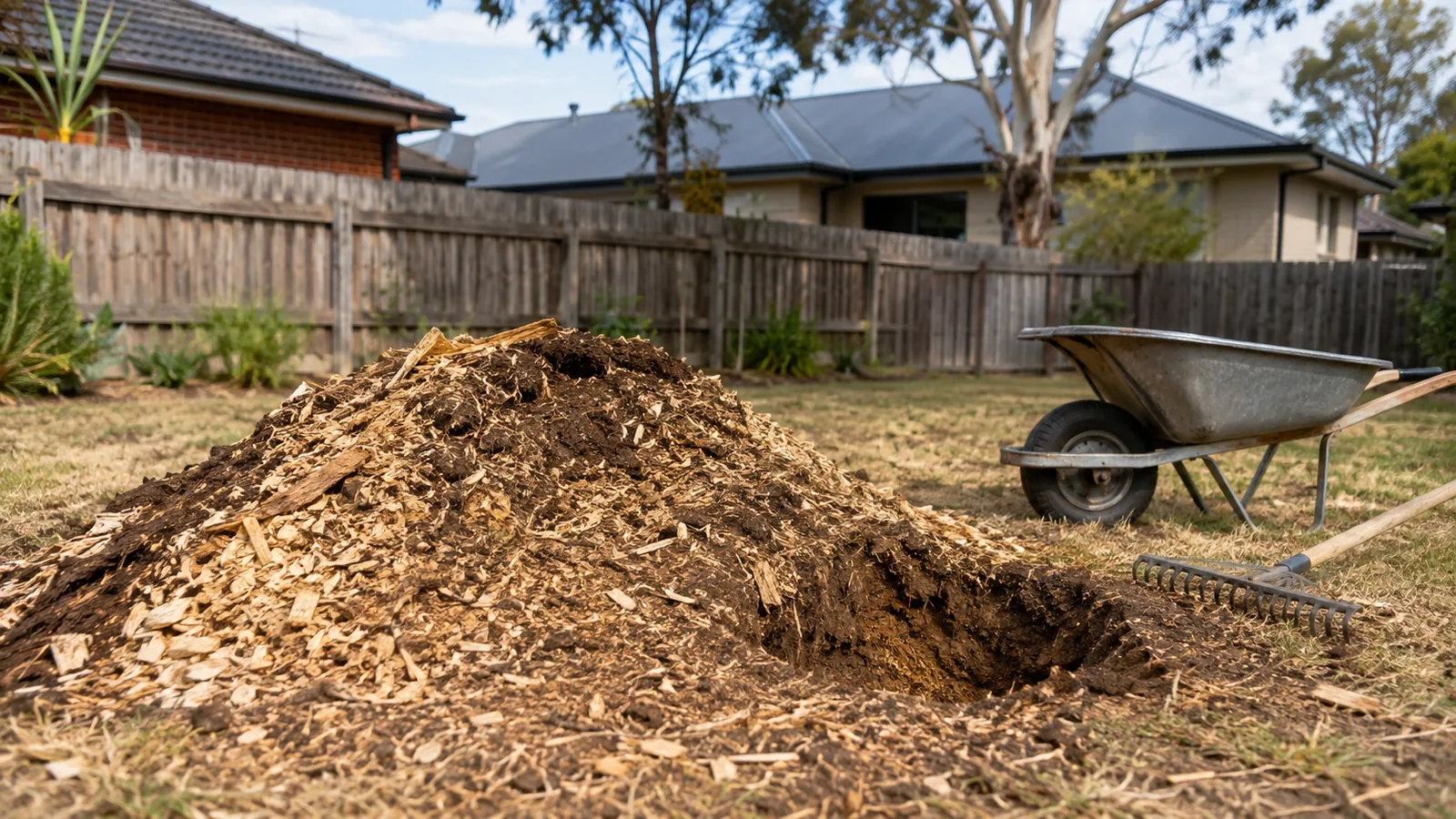
A ground stump yields two to three times its own volume in chip, because the material fluffs as it is cut and picks up soil on the way. On a big old paddock gum that is a substantial heap. The standard suburban answer is either to rake it back and mound it, or to pay $120 to $350 to have it carted off and another $80 to $220 for clean topsoil backfill.
Out here that second option is usually a waste of your money, because the reason people pay for it does not apply. Nobody on ten acres minds a mound of grindings behind a shed. There is almost always somewhere the material can go and do some good: along a back fence line where a thick layer suppresses weeds, on a farm track or a gateway where a coarse fill firms up a soft spot, or simply heaped in a back corner to break down on its own.
Two limits are worth knowing. Grindings are not arborist mulch and should not be treated as it. They carry soil, grit and stones, they are inconsistent in size, and they can carry pathogens from whatever killed the tree, so they are poor around garden plants. And fresh grindings have a very high carbon to nitrogen ratio, which means they pull nitrogen out of anything trying to grow in them. That is why grass sown straight into a grindings backfill goes yellow and why a replacement tree planted into raw chip struggles. If you are replanting in the same hole, the spoil comes out and clean soil goes in, on acreage the same as anywhere else. The full reasoning is in what to do with stump grindings.
Old farm timber is harder than it looks.
The trees out here are a farm inventory rather than a landscape one. Paddock sugar gums, planted or self-sown and left to grow in the open. Old cypress windrows along boundaries and around the yards. Peppercorns around the sites of former farmhouses, some of which outlived the house by decades. All of them are old, and old farm timber is the hardest cutting in the shire.
Three things stack up on a paddock sugar gum. It is dense hardwood, so teeth blunt several times faster than on a pine or a fruit tree. It grew with no competition, so instead of a tidy trunk it has a wide buttressed flare that spreads out before it turns down, and the machine has to clear that whole footprint to reach the depth you asked for. And decades of soil moving around an isolated tree pack grit and small stones into the bark fissures and the top of the flare. Grit is what actually destroys carbide teeth, more than the timber does.
That combination is why a big paddock sugar gum sits in the $800 to $1,500 band rather than the $450 to $800 its measured diameter might suggest. Cypress is similar for a different reason: hard, resinous and usually planted in a close run so neighbouring root systems interlock. Peppercorns are softer cutting but often multi-stemmed with a sprawling base, which puts them past the single-stump bands on footprint alone. Species by species is in gum, palm and pine stump removal.
Say it when you ring: if a stump is on or near a current or former fence line, tell us. Old boundaries move, and a tree that grew on one will have wire, staples or a strainer post grown into its base. Steel does exactly what rock does to carbide teeth. A minute on the phone about that saves an hour and a set of teeth on site.
Alluvial soil, good depth, one weather problem.
The flats around Nar Nar Goon are alluvial with decent soil depth, which is easier ground than either the heavy clay to the west or the peat and sand to the south. It cuts cleanly, it does not blunt teeth the way sand does, and the grindings rake back without turning into the paste that wet Pakenham clay produces. Backfill settles moderately, less than in Koo Wee Rup peat and about the same as clay, so a mounded finish holds up.
The one weather constraint is different from a suburban job. On a house block the problem after rain is ruts across a lawn. Out here the problem is getting a loaded truck through a gate and across a paddock without bogging it, and soft alluvial ground after a wet week will do exactly that. A day of clearing that turns into half a day of recovery helps nobody, so we would rather move a booking than push into ground that is not ready. That is worth factoring in if a build or a fencing contractor is waiting on the clearing.
Depth still gets set by the end use, the same as anywhere. Paddock going back to grass wants 150mm and no more, because turf roots do not go deeper and everything past that is money spent moving dirt. A new shed, a slab or a footing over the spot means the stump should be dug out rather than ground, because a rotting root plate under concrete becomes a void. On acreage that comes up more than people expect, since cleared ground is usually cleared for a reason. The distinction is covered in stump removal before a shed or extension.
What acreage work costs.
| Job | Price | When it applies |
|---|---|---|
| Single stump, under 300mm | $180 - $280 | A fruit tree or a small self-sown wattle. Worth combining with a neighbour's. |
| Single stump, 300 - 600mm | $280 - $480 | A mid-sized gum or an established garden tree near the house |
| Single stump, 600 - 900mm | $450 - $800 | Windrow cypress, a mature peppercorn, a smaller paddock gum |
| Over 900mm or multi-stem | $800 - $1,500+ | Big old paddock sugar gum with a buttressed flare |
| Block or windrow clearing | $1,400 - $2,600 per day | Four or more stumps, or any run. Nearly always cheaper than adding up singles. |
The one thing not to pay for out here: cart-away at $120 to $350 a stump, when the property has a back fence line, a shed corner or a soft gateway that would take the grindings for nothing. Spend the money on getting the depth right instead, or on having every stump on the block done in the same visit while the machine is already there.
Questions from Nar Nar Goon.
Why is clearing priced by the day out here instead of per stump?
Because on open ground the set-up is what costs and the cutting is comparatively cheap. Per-stump pricing exists to cover travel, unloading, walking a machine through a house block, screening and packing up, and on a small residential stump that overhead is most of the price. On acreage with a gate the truck can drive through, all of that happens once for the whole property. A day rate of $1,400 to $2,600 buys the machine working continuously, and on a run of paddock stumps or an old windrow that will nearly always beat adding up individual stump prices.
Should I pay to have the grindings carted away from a farm block?
Usually not. Cart-away runs $120 to $350 per stump and clean topsoil backfill another $80 to $220, which is worth spending on a suburban lawn where a mound is an eyesore or a trip hazard. On acreage there is almost always somewhere the grindings can go: behind a shed, along a back fence line as weed suppression, or on a farm track where coarse fill is useful. They make poor garden mulch, because they carry soil, grit, stones and sometimes pathogens from the tree that died, but as a path fill or a back-corner heap they cost nothing and do no harm.
Why are old paddock sugar gum stumps so hard to grind?
Three reasons stack up. Sugar gum is dense hardwood, so carbide teeth blunt several times faster than on pine or a fruit tree. A paddock-grown tree with no competition spreads a wide buttressed flare rather than a neat trunk, so the footprint to clear is far larger than the diameter you measured. And decades of soil movement around an isolated tree pack grit and small stones into the bark fissures and the top of the flare, and grit is what actually destroys teeth. A big old sugar gum is an $800 to $1,500 job and the wide flare is most of the reason.
Can you get to stumps in the middle of a paddock?
Yes, and open access is the single biggest cost advantage of working out here. A stump the machine can drive to and circle gets cut from every angle, because the wheel sweeps across the face rather than boring in, and that finishes far faster than the same stump wedged against a fence on a suburban block. The two things that still slow a paddock job are wet ground, since a loaded truck and a tracked machine both mark soft alluvial soil badly after rain, and old fence lines, because a tree that grew on one has wire or staples in its base and steel wrecks carbide teeth.
Also working across the shire.
Count the stumps before you ring.
Out here the number that decides how the job is priced is how many, not how wide. Four or more, or any windrow, and the day rate is the conversation.