Multiple stumps and whole-block clearing.
One stump is priced off its diameter. Twenty is a different job with different arithmetic, and past about eight stumps per-stump pricing stops making sense. Clearing is quoted at $1,400 to $2,600 a day, and on a build site the depth spec and the sequencing matter more than the rate does.
Where per-stump pricing stops working.
Single-stump pricing has a fixed cost baked into it. The travel, the unload, the services check and the set-up are the same whether the machine cuts one stump or fifteen, which is why the second and every later stump on the same visit is 30 to 50 per cent cheaper than it would be on its own. That discount only stretches so far. Once the count gets high enough that the machine is cutting all day, the sensible unit is the day, not the stump.
Work it through on a mid-sized stump, call it 400mm across, which prices at $280 to $480 standalone. Take $380 as the middle and apply a 40 per cent discount to every stump after the first.
| Stump count | Priced per stump | Same work on a day rate | Which is cheaper |
|---|---|---|---|
| 4 stumps | About $1,060 | Half a day is still charged as a day, $1,400 to $2,600 | Per stump, clearly |
| 8 stumps | About $1,976 | One day, $1,400 to $2,600 | Line ball, decided by access |
| 20 stumps | About $4,712 | Roughly a day and a half, $2,100 to $3,900 | Day rate |
| 40 plus stumps | Not worth calculating | Three to five days depending on size | Day rate, by a wide margin |
The crossover moves. Big hardwood stumps push it up, because a day gets through fewer of them and carbide teeth blunt several times faster in red gum, ironbark and cypress than in pine or willow. Small softwood stumps in open paddock pull it down, because the machine barely stops. Tell us the count and a rough size range and we will price it both ways and quote whichever is lower. The single-stump bands are on the 2026 price guide.
Four situations that come up around Cardinia.
Multi-stump work here is not one type of job. The four below cover most of what we are called out to, and each has a different constraint driving the price.
- A build site in Officer. Trees felled by someone else, six to fifteen stumps left across a lot that a builder needs handed over clean. The constraint is the depth specification and the fact that everything organic has to leave the site, so cartage is a real cost.
- An old windrow along a boundary. Cypress or radiata pine planted as a shelter belt seventy years ago, now a line of twenty to sixty stumps down a fence at Nar Nar Goon or Koo Wee Rup. The constraint is fence clearance, because the machine has to sweep across each stump and half of them sit within a metre of the boundary.
- Subdivided acreage. A block being cut into lots, mixed stump sizes, no fences to work around yet. The constraint is sequencing, because doing it before the earthworks costs a fraction of doing it after.
- Paddock reverting. Wattle, blackberry and self-sown gums taken out of a paddock that has been left alone for fifteen years, leaving a scatter of small stumps over acres. The constraint is walking time between them, and this is the job type where a day rate is most obviously the right structure.
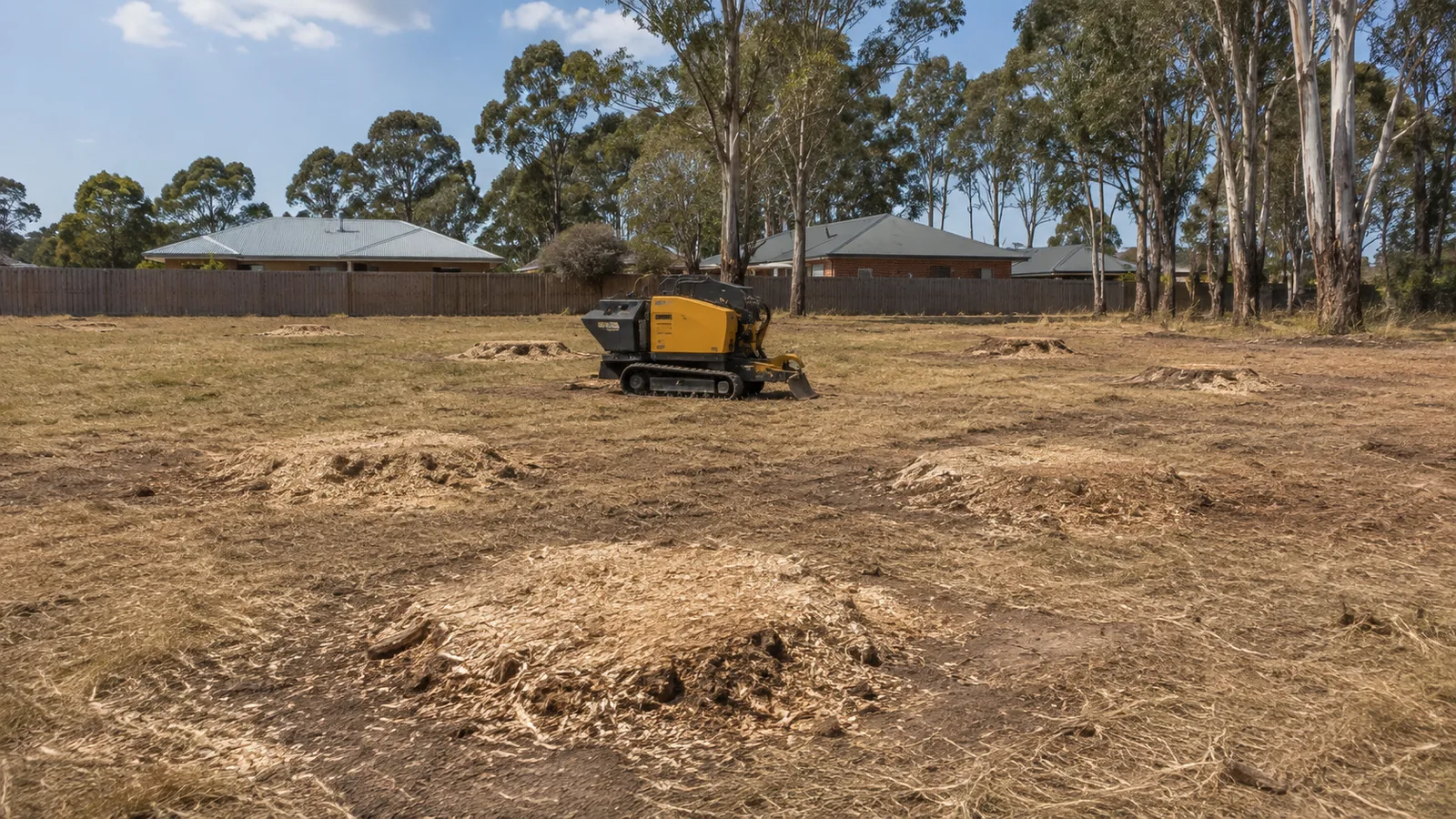
Depth matters more when footings and services are coming.
On a residential lawn a stump ground to 150mm is finished, because turf roots do not go deeper and anything more is paid-for dirt movement. On a block that is about to be built on, that same 150mm is close to useless. Footings, slab preparation, stormwater and conduit all work well below it, and a root plate left at 200mm is in exactly the wrong place for every trade that follows.
The rule we work to is straightforward. Anywhere a slab, a footing or a structural load is landing, the stump does not get ground at all, it gets excavated with the root ball, because decomposing timber under concrete leaves a void and a void under concrete becomes a crack. That method is set out under full stump removal. Everywhere else on the lot, driveways, paths, garden and lawn, grinding is fine as long as the depth is set against the end use rather than against whatever the machine reached. The depth table for each end use is in how deep to grind a stump.
Services deserve their own paragraph on a development block. New estates around Officer and the Pakenham growth corridor have conduit, water services, stormwater and telecoms lead-ins all through the top half metre, and a grinding wheel works in exactly that band. A free Before You Dig Australia enquiry returns asset-owner plans, not a mark-out, so anything close still gets potholed by hand or located privately at $250 to $600. On a job where a machine is going to cut twenty times in a day, that check is cheap insurance.
Twenty stumps make a great deal more chip than you think.
A single ground stump yields two to three times its own volume in material, because the wood fluffs as it is cut and picks up soil on the way through. That is a manageable heap in a backyard. Multiply it by twenty or fifty and it becomes a logistics item with its own cost, and it is the line most often left off a clearing quote by whoever is trying to look cheapest.
What happens to it depends on the site. On acreage the cheapest and usually the best answer is to leave each heap where it falls, or push them into one pile on a back boundary where the material breaks down over a few years and suppresses weed in the meantime. Grindings are poor garden mulch, since they carry soil, grit and stones, they are inconsistent in size, and fresh material has a high carbon to nitrogen ratio so it robs nitrogen from anything trying to grow in it. The full explanation is in what to do with stump grindings.
On a build site none of that applies, because the material has to leave. Cartage runs $120 to $350 per stump equivalent, and clean topsoil backfill where a hole needs filling is another $80 to $220. On a forty-stump job those two lines can be a larger number than the grinding itself, so they belong in the quote as separate items you can see and question.
Stumps out before the site is levelled.
The most expensive version of this work is the one where somebody rings after the earthworks. Once a site has been cut and filled to a design level, the stumps that stood on the original surface are buried under 300 or 600mm of fill. They still have to come out, so now the fill gets dug up, the stump gets removed, the hole gets backfilled and compacted, and the level gets re-established. All of that is work already paid for once. The same logic applies to services: a grinder working in the top 300mm over freshly laid conduit is slow and careful work, and it costs accordingly.
The order that costs least is trees down, stumps out, services in, then level and compact. It also has the useful side effect that any stump found to be bigger than it looked, or sitting somewhere a footing is going, can be dealt with while the site is still open and before anyone has committed to a set-out.
One separate point on a block being developed: the permit question attaches to the standing trees, not the stumps. Grinding something already cut is not normally a permit matter in Cardinia Shire, while a living tree with a trunk circumference of 110cm or more at 1.4m above ground is covered by the Tree Protection Local Law, and indigenous remnants including River Red Gum, Yellow Box, Manna Gum, Messmate Stringybark and Blackwood are protected at any size. Planning Scheme overlays sit on top of the Local Law and run to their own timeframe. Sort that out before the felling contractor books in, and check the current requirements with Cardinia Shire directly because the detail changes.
Questions about clearing.
When does a day rate beat paying per stump?
At around eight stumps the two ways of pricing meet, and past that the day rate wins by a widening margin. Eight mid-sized stumps priced individually come to roughly $2,000 once the extra-stump discount is applied, which is about what a day costs. Twenty of the same stumps come to around $4,700 per stump, and twenty is a day and a half of actual cutting, so the same work on a day rate is $2,100 to $3,900. The crossover moves with size and access: big hardwood stumps push it up, small softwood stumps in open paddock pull it down.
What does a day of clearing actually include?
A clearing day is $1,400 to $2,600 depending on machine size and site conditions, and it covers the machine, the operator, fuel and teeth for the day. What it does not automatically cover is cartage of the spoil, and on a multi-stump job that is the line worth checking, because the volume is far larger than people expect. Site set-up time, walking between stumps on acreage, and any hand work around fences or services all come out of the same day, so an open paddock gets through far more stumps in eight hours than a fenced block with a dozen obstacles.
Where do the grindings go when there are twenty stumps?
Each stump makes two to three times its own volume in chip, so twenty mid-sized stumps produce a genuine pile, commonly several cubic metres. On acreage the usual answer is to leave each heap where it falls or push them into one spot on a back boundary, which costs nothing. On a build site it all has to go, because organic material is not acceptable fill and the site has to be handed to the builder clean. Cartage runs $120 to $350 per stump equivalent, so on a large job it is worth pricing as its own item rather than assuming it is included.
Do we need a Cardinia Shire permit to clear stumps on our block?
Grinding stumps that are already cut is not normally a permit matter, because the Tree Protection Local Law covers living trees rather than dead stumps. The permit question applies to the standing trees, and on a block being developed that is the part to sort out first. A living tree with a trunk circumference of 110cm or more measured at 1.4m above ground is in scope, and indigenous remnant species including River Red Gum, Yellow Box, Manna Gum, Messmate Stringybark and Blackwood are protected at any size. Overlays under the Planning Scheme sit on top of that and take longer. Check the current requirements with Cardinia Shire.
When in a build program should the stumps be done?
Before the site is levelled and before services go in, not after. Once a site is cut and filled to level, the stumps that were on the original surface end up buried under fill, and finding them again means digging up work that has just been paid for. Once conduit, stormwater and water service runs are in the ground, a grinder working in the top 300mm is operating right on top of them and the job becomes slow, careful and dearer. The cheapest sequence is trees down, stumps out, services in, then level.
Clearing across the Cardinia Shire.
Send the stump count and a rough size range.
A count, a size range and one photo across the block is enough to price a clearing job both ways. If per-stump comes out cheaper for your numbers we will quote it that way and say so. Grinding a single stump is covered under stump grinding.