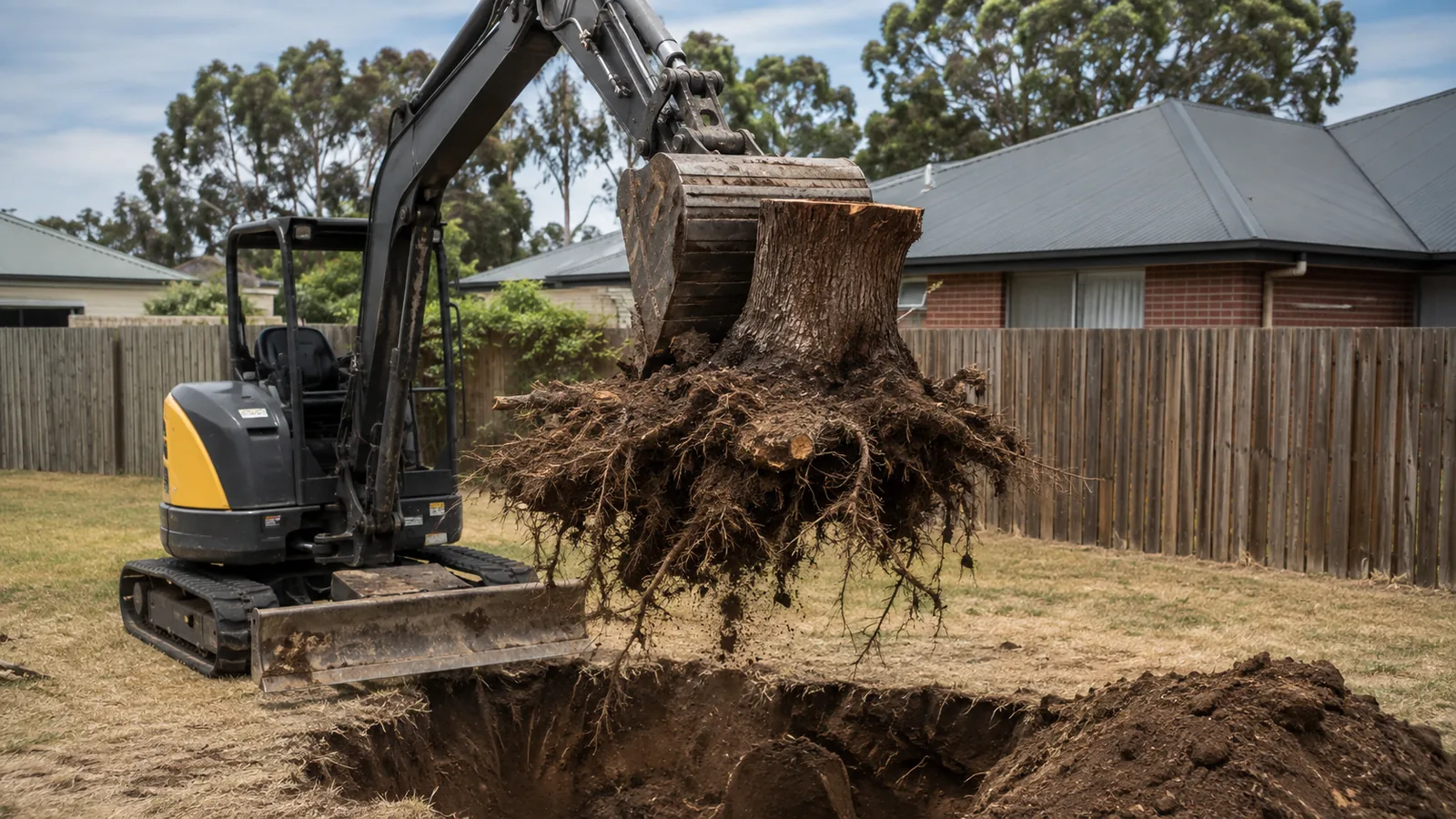
Full stump removal, root ball and all.
Digging the whole stump out with a machine instead of grinding it down. It costs two to four times what grinding costs, it leaves a crater, and it is the only correct method when a slab, a footing or a pool shell is going over that exact spot. For everything else, grinding is the better buy and we will say so.
An excavator, a crater and a truck.
Full removal has nothing in common with grinding except the end result being a patch of bare ground. A three to five tonne excavator or a backhoe digs a ring around the stump, cutting the lateral roots with the bucket edge as it goes, works in underneath the root plate, and then levers the whole mass out in one piece or in two or three large ones. On a mature gum the root ball that comes out can weigh more than the machine lifting it, which is why digger sizing matters and why a mini excavator is not always enough.
What comes out then has to go somewhere. A 600mm stump with a normal spreading root plate produces a root ball roughly a metre and a half across, plus the loosened soil that came out with it. That does not fit in a ute. It is a truck load, or on a multiple-stump job several truck loads, and cartage is a real line on the quote rather than a rounding error. Timber that size is awkward to dispose of as well, since it is soil-contaminated and full of grit, so it goes to a green waste transfer station rather than through a chipper.
Grinding leaves the root system in place and lets it rot over five to fifteen years, which is entirely fine under a lawn. Excavation removes the organic material from the site, which is the whole point of it. If you are unsure which side of that line your job sits on, the method is set out in how stump grinding works and compared side by side in grinding versus full removal.
The triggers that rule grinding out.
There is a short list of situations where the root plate has to physically leave the site. Outside that list, paying for excavation is money spent for no gain.
| What is going in | Method | Why grinding fails there |
|---|---|---|
| Concrete slab, house extension | Excavate | The remaining root plate rots, the ground drops into the space it leaves, and the slab cracks into the void |
| Shed or garage footing | Excavate | Footings have to bear on soil, not on decomposing timber that loses volume every year |
| Pool shell | Excavate | The dig goes well below any grind depth anyway, and a shell bearing on soft spots moves |
| Retaining wall footing | Excavate | A retaining wall carries lateral load. Settlement under one pier shows up as a lean |
| Service trench through the spot | Excavate | You cannot lay stormwater, sewer or conduit through a root plate, and a trench beside one collapses |
| Driveway subgrade | Usually excavate | Concrete and asphalt both crack over a settling patch, and a driveway is the dearest thing to redo |
| Fence line | Depends on post depth | Sometimes grinding deep enough clears the post holes. A post landing on the old plate will move |
The mechanism, in one sentence: wood underground loses volume as it decomposes, the soil above drops into the space, and anything rigid spanning that spot cracks. It takes three to eight years, which is long enough that nobody connects the crack back to the stump. The slab case is worked through in stump removal before a shed or extension.
Backfill is the part people forget to price.
Once the root ball is on the truck you are left with a hole roughly 1.5 to 2 metres across and 800mm to 1.2 metres deep for a mature stump. The spoil that came out of it will not simply go back, because a good share of it left with the root ball and what remains has been broken up and has lost its density. Tipping loose soil back in and raking it flat looks finished on the day and is the most common way a removal job goes wrong.
Done properly, the hole is refilled with imported fill in layers of about 150 to 200mm, each layer compacted before the next goes on. On a build site that fill is usually a specified material, crushed rock or a sand and clay blend, and the compaction is to a standard your engineer names. Uncompacted backfill under a slab consolidates under its own weight and the load above it, and it does not stop at a couple of millimetres. That is why the backfill line on a quote matters more than the excavation line, and why two quotes for the same stump can sit $600 apart without either being wrong.
On the Pakenham and Officer flats the native ground is heavy grey and brown clay, which compacts well but is unforgiving when wet, so winter work needs the weather watched. Down on the old swamp country around Koo Wee Rup the peat and sand profile slumps considerably more after any excavation, and a hole backfilled there without proper compaction keeps moving for a year or more.
It is destructive, and nine times in ten you do not need it.
An excavator does not tiptoe. It needs a route in wide enough for tracks and a bucket, room to slew, and somewhere to stack spoil while it works. What that costs your yard is worth knowing before you book it.
- Lawn gets tracked. On dry ground that recovers with a rake. On wet Cardinia clay a loaded machine leaves ruts that need topsoil and reseeding.
- Garden beds next to the stump go. The ring dug around a root plate is wider than the stump by a metre or more on each side, and established shrubs inside that ring will not survive being undercut.
- Shallow services are at risk. Irrigation, garden lighting, a private power run to a shed and telecoms lead-ins all live in the top 300mm. A free Before You Dig Australia enquiry is the starting point, and anything close still needs potholing or a private locate at $250 to $600.
- Access may cost a fence. A 760mm grinder walks through a side gate. An excavator does not. Pulling a fence panel and reinstating it is normal on this work, and it belongs on the quote rather than turning up as a surprise. Machine sizing is covered in backyard access and machine size.
Against that, grinding costs a third to a half as much, is normally finished inside an hour or two, and leaves the surrounding yard intact. Where the ground is going back to lawn or a garden bed, grinding to the right depth gives a better result for less money and there is no engineering argument for digging. Multiple stumps on a block being cleared are a different calculation again, priced by the day under block and acreage clearing.
Questions about full removal.
What is the difference between stump grinding and full stump removal?
Grinding cuts the stump into chip from the top down and leaves the root system in the ground to break down on its own over roughly five to fifteen years. Full removal digs the stump and the root ball out whole with an excavator or a backhoe, so no organic material is left in the hole. Grinding is faster, costs less and does far less harm to the rest of the yard. Excavation is slower, costs two to four times as much, and leaves a crater that has to be backfilled and compacted properly. Excavation is the correct method when something structural is being built on the spot, and the wrong one almost everywhere else.
How much does full stump removal cost compared to grinding?
Budget two to four times the grinding price for the same stump. A 400mm stump that grinds out for $280 to $480 is more likely $700 to $1,600 excavated, and the spread is wide because most of the cost sits outside the digging: machine float in and out, the volume of spoil that has to be carted away, and the engineered fill and compaction needed to put the hole back. Access drives it too, since an excavator needs a much wider route in than a 760mm grinder and often needs a fence panel out. Get the quote in writing with the backfill included, because backfill is where quotes differ most.
What happens to the hole after the stump is dug out?
A 600mm stump with a normal root plate leaves a crater roughly 1.5 to 2 metres across and 800mm to 1.2 metres deep. The spoil that came out will not go back in, because the root ball is going on the truck and the remaining soil has broken up and lost its density. The hole is refilled with imported fill placed in layers of about 150 to 200mm and compacted between each layer. Soil tipped in loose and left will settle for years, and a slab poured over poorly compacted backfill settles with it. Where a footing is going in the same spot, the engineer usually specifies both the fill type and the compaction standard.
When will a builder or engineer require full removal in writing?
Anywhere a footing, a slab or a structural load lands on the ground the tree stood in. Shed slabs, house extensions, garage footings, pool shells, retaining wall footings and driveway subgrade are the common ones. Some soil reports and engineering details on reactive clay sites name it directly, because organic material is not acceptable founding material. If your building surveyor or engineer has asked for the stump and root ball out, grinding to 300mm does not satisfy that requirement no matter how deep it looks on the day. Ask for the requirement in writing and hand it to whoever is doing the work.
Will excavating a stump wreck the rest of my garden?
It does more damage than most people expect. A three to five tonne excavator needs a route in, room to swing, and somewhere to stack spoil, so lawn gets tracked, garden beds beside the stump usually come out, and anything shallow in the top 300mm, irrigation, garden lighting or a private power run to a shed, is likely to be cut. On a tight block the machine may need a fence panel removed to get in at all. None of that is a reason to avoid excavation when a slab is coming. It is a reason to sequence the work before landscaping rather than after.
Excavation across the Cardinia Shire.
Tell us what is being built and we will tell you which method you need.
Send the stump diameter, a photo showing the access, and what is going on the spot afterwards. If grinding will do the job we will quote grinding, because it is cheaper for you and quicker for us.