Will the machine fit? Measure it yourself in five minutes.
Nearly every quote for a backyard stump turns on one number: the narrowest point between the kerb and the stump. Most people measure the gate, which is almost never the tightest gap. This is how to measure it properly, what to look for on the way, and what the answer means for the price.
Measure the route, not the gate.
Take a tape measure and walk the exact path a person would walk pushing a wheelbarrow from the street to the stump. Every time the gap tightens, stop and put the tape across it. You are looking for one number: the smallest clear width anywhere on that route. That is the number a contractor needs, and it is the only one that decides anything.
Three details change the reading, and all three catch people out. First, open the gate fully and latch it back against the fence before you measure. A gate leaf that only swings to seventy degrees steals 50 to 80mm off the opening, and a machine does not care that the gate could theoretically open further if the hinge were not binding on the paving. Second, measure at about knee height rather than at ground level, because the body of a machine sits above its tracks and the gap that matters is the gap at that height. Third, measure the clear opening between the things that are actually there, so if a wheelie bin lives permanently in the side passage, either move it or measure as though it stays.
Gate posts are not the measurement. People measure post to post, get 900mm, and assume they are fine. The gate leaf, its hinges, the latch hardware and the drop bolt all sit inside those posts, and on a timber gate the leaf itself is 35 to 45mm thick, sitting proud of the post when it is swung back. Measure the hole you can actually walk through with the gate held open.
The checklist, and why each line is on it.
Five measurements and two notes. If you send us these with a photo taken from a couple of metres back, most residential jobs can be priced without anyone driving out to look.
| Measure | How | Why it matters |
|---|---|---|
| Narrowest point on the route | Tape across the tightest gap, at knee height, gate latched open | This single number decides which machine comes, and whether the job is straightforward |
| Gate clear opening | Between the open leaf and the far post, not post to post | The leaf, hinges and latch all eat into the opening you think you have |
| Lowest overhead clearance | Ground to the underside of an eave, arch, clothesline or low branch | A machine that fits sideways can still be stopped by a 1.6m garden arch |
| Any step or level change | Height of each step, and how many | Tracks climb a slope but not a vertical face. A 200mm brick edge is a hard stop |
| Room around the stump | Clear space on each of the four sides | The wheel sweeps sideways, so a stump you can circle is far faster than one wedged in a corner |
| Surface underfoot | Note lawn, concrete, pavers, gravel, bare clay | Sand-set pavers and soft wet clay change the method, not just the time |
| Recent rain | Just tell us if it has been wet | On the Cardinia flats, a fortnight later can mean a lawn that rakes out instead of ruts |
Ten pinch points that are not the gate.
The gate is usually the widest part of a side passage, not the narrowest. Everything below sits somewhere along the route and is invisible from the front of the house, which is why we ask rather than assume.
- The meter box. Bolted flat to the wall on the side of the house, projecting 100 to 150mm into a passage that might only be 900mm to begin with. On many estate blocks this is the tightest point on the property.
- A rainwater tank. Slimline tanks are put down the side because that is the only place they fit, which by definition means the passage is now narrower than it was designed to be.
- The air-conditioning condenser. Same wall, same problem, and often on a bracket that puts the corner of the unit right at machine height.
- A downpipe with a rainhead or a leaf diverter. The pipe itself is 90mm, but a diverter or a stormwater inspection riser can double that.
- A retaining wall step. Common on the sloping blocks through Beaconsfield and Pakenham Upper. It is a level change as well as a width restriction, and the two together are what stops the job.
- A gate that opens onto a step. The gate swings fine, the opening measures fine, and there is a 150mm drop immediately on the other side of it that no tracked machine will negotiate.
- An overhanging eave or a pergola beam. Height, not width. Worth a tape measure if it looks tight.
- The clothesline post. Rotary line posts are set in concrete in the middle of the back lawn, precisely where the route to a rear corner stump wants to go.
- Low branches. A neighbour's overhanging shrub or your own low-slung crepe myrtle will not stop a machine, but it slows the walk in and it is worth mentioning.
- A garden arch or an ornamental gate. Usually around 1.6 to 1.8m high and often only 700 to 800mm wide. Frequently the reason a machine gets to the back lawn but not to the stump.
If any of those are on your route, measure them and tell us the number. It costs nothing at the quoting stage and it prevents the single most annoying outcome for everyone, which is a machine on a trailer in your driveway that cannot get to the work. The service side of tight-access jobs, including how we work a stump that can only be swept from one direction, is covered on narrow access stump grinding.
What 760mm gets you, and what happens either side of it.
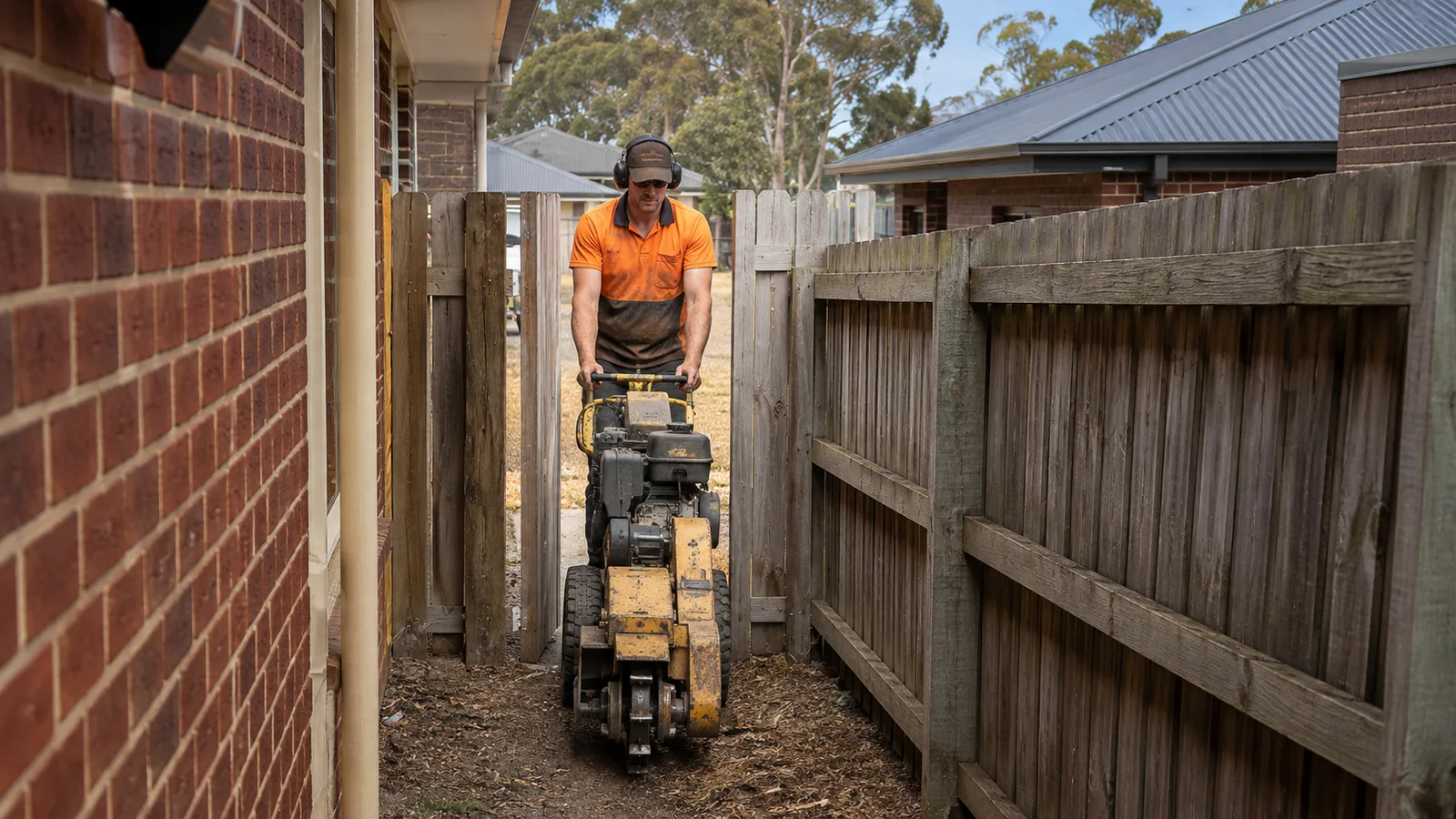
760mm is the width of the narrow-access machine used on this site. It is not an industry standard, it is simply the machine, and it is chosen because a standard single side gate on an estate block gives 800 to 900mm of clear opening. Through Officer, Cardinia Lakes, Arena, Timbertop and Heritage Springs, that covers the large majority of blocks built in the last twenty years.
Above 760mm the job gets easier and often cheaper, because a bigger machine has more wheel, more weight and more power, and it cuts a large gum stump in a fraction of the time. If you have a 1.2m double gate or a driveway that runs down the side to a rear shed, say so, because it may move your job into a lower price for the same stump.
Below 760mm you have not run out of options, but the options change. Between roughly 600 and 760mm the usual answer is to remove one fence paling or lift the gate leaf off its hinges. A paling is two screws and it goes back the same day. Under 600mm with no removable panel, a machine is not coming through and the honest conversation is about hand digging, lifting the machine over the fence, or leaving the stump. See the section below for what those actually cost you.
The measurement most people get wrong: 900mm post to post with a timber gate hung between them is not 900mm of access. Subtract the leaf thickness where it swings back, the hinge knuckle and the latch, and you can be down near 780mm of true clear opening. Measure the hole, not the frame.
Ground: what the machine has to drive over.
Width tells you whether the machine can get there. Ground tells you whether it should. These are separate questions and a wide, level, completely accessible route can still be the wrong route.
Soft wet clay is the common one here. The Pakenham and Officer flats are heavy grey and brown clay that holds water, and after a wet week it goes greasy. A tracked machine on greasy clay marks the lawn badly, and the grindings mixed into it turn into a sticky mess that will not rake level. Nothing about that is unsafe, it just produces a worse finish, so on a lawn you care about there are weeks where booking a fortnight later is the better call.
Unsupported pavers and sand-set paths are a firm no. Those are bedded on sand with no footing under them, and running a machine across them rocks them out of level. Where it is the only route we lay boards to spread the load, which adds a few minutes and solves it. A properly laid concrete driveway or path is fine.
Then there are the things you must not drive over at all, and you know where they are better than any contractor arriving for the first time. A septic tank lid or an absorption field, common on the acreage blocks around Nar Nar Goon and out past Tynong, will not take a machine and the field itself can be damaged by compaction alone. A rainwater tank lid or an in-ground tank slab is the same. Old brick or concrete pit covers over stormwater are frequently thinner than they look. Point them out before we start, or mark them with a peg.
What is under the ground is a separate question again, and a more serious one, because the grinder wheel works in exactly the top 300mm where shallow services live. That is covered in full on underground services before stump grinding, and it is worth reading before you book anything near a boundary or a meter.
Slope and steps.
Level change is its own limit and it is not related to width. A tracked grinder will walk up a moderate grassed slope without complaint. It will not climb a vertical face, so a single 200mm brick garden edge, a step down into a sunken lawn or a three-step drop off a deck is a stop regardless of how wide the opening is.
Side slope matters more than grade. Travelling straight up or down a hill is far safer than travelling across it, because across the fall the machine's centre of gravity works against it. On the steeper blocks through Pakenham Upper and Beaconsfield Upper, the slope rather than the gate is normally what decides the method, and on the worst of them the answer is a smaller machine and a longer day rather than a bigger machine and a short one.
Measure the height of any step on the route and count how many there are. Two 100mm steps and one 200mm step are very different problems, and the fix for the first is often a couple of scaffold planks.
The four honest options.
Sometimes the answer is genuinely no. Here is what is actually on the table, with the trade-off named.
- Take out a fence paling or a gate leaf. Cheapest by a distance and it is what we suggest first. Two screws, one paling out, machine through, paling back. Even on a colorbond fence a single panel can often be unclipped. If your neighbour has a wider gate and is agreeable, that route counts too.
- Lift the machine in. A crane or a truck-mounted lift over the fence works, and on a commercial site it is routine. On a single residential stump the lift usually costs more than the grinding, so it is rarely the right answer and we will say so.
- Hand dig. Realistic for a small soft stump, a fruit tree or a shrub under about 250mm across, especially in the sandy ground down towards Koo Wee Rup. Not realistic for a gum. A mature gum root flare hand dug is a day of work and the labour costs more than a machine job on an accessible block. A palm is the exception again, because the root ball is small enough to dig, which is one of several differences set out on gum, palm and pine stump removal.
- Leave it. A stump in a back corner, with nothing being built on it and nothing being planted in it, costs you nothing to leave. It will break down on its own over ten to twenty years. Keeping your money is a legitimate outcome and it is the right one more often than the trade admits.
Whichever it is, you get told before anyone books a truck. Prices for each of the workable options are on the 2026 price guide, and if the stump turns out to be one that needs excavating rather than grinding, that decision is explained on grinding versus full removal.
Access questions we get asked.
What width do I need to measure for a stump grinder?
Measure the narrowest point on the entire route from the kerb to the stump, not the gate. Walk the path you would walk with a wheelbarrow, and every time the gap tightens, put the tape across it. Measure at about knee height, because a gap that is wide at ground level often narrows above it where a meter box or a tank sits. Open the gate fully and latch it back first, since a half-open leaf steals 50 to 80mm. Write down the smallest number you find. That one figure decides whether the job is a straight grind or something more involved.
Will a stump grinder fit through a 760mm side gate?
Yes. The narrow-access machine here is 760mm wide, which is why that is the number we ask about. A standard single side gate on an estate block in Officer, Cardinia Lakes, Arena or Heritage Springs gives 800 to 900mm of clear opening, so it goes through with room. The catch is that the gate is rarely the tightest point. The meter box side of the house, a slimline rainwater tank or an air-conditioning condenser past the gate is what actually stops a machine, and none of those are visible from the front of the property.
Can a stump grinder go over my lawn and pavers?
Over lawn, usually yes. A tracked machine spreads its weight well and on dry ground leaves track marks that rake out. Wet clay is the exception, and on the Pakenham and Officer flats in winter the ground goes greasy enough that rescheduling gives a visibly better lawn. Over unsupported pavers or a sand-set path, no. They are bedded on sand with no footing and a machine rocks them out of level. Where that is the only route we lay boards across the run to spread the load, which adds a little time and no drama.
What happens if nothing fits and the machine cannot reach the stump?
Four options, none of them a disaster. Take out one fence paling or lift the gate leaf off its hinges, which is often twenty minutes and by far the cheapest fix. Lift the machine in over the fence, which is rarely worth the cost on a single residential stump. Dig it out by hand, which suits a small soft stump but not a gum. Or leave it, which is a real option when the stump is not in the way of anything. We would rather tell you on the phone that the answer is a fence paling than turn up, discover it and charge you a call-out.
Does a slope or a step stop a stump grinder?
It can, and it is separate from width. A tracked machine climbs a moderate grass slope but not a vertical face, so a single 200mm brick edge or three steps into a sunken yard is a hard stop even with a metre-wide gate. Side slope is the bigger safety limit, because a machine travels up and down a grade far more safely than across it. On the Pakenham Upper hills and the steeper Beaconsfield blocks the slope, not the gate, usually decides the method. Measure the step height and tell us.
Send the narrowest number and a photo from a few metres back.
That plus the stump diameter is enough for a firm price on most residential jobs in Pakenham, Officer, Beaconsfield, Nar Nar Goon, Pakenham Upper and Koo Wee Rup, without anyone driving out to measure it for you.