Narrow access grinding, decided by one measurement.
Whether a backyard stump is a straightforward job or an awkward one comes down to the narrowest gap between the street and the stump. Our machine needs 760mm. Almost nobody measures the right point, which is how people end up paying a call-out fee for a job that was never going to happen.
760mm, at the tightest point of the route.
A narrow-access grinder is built around one dimension. At 760mm across it fits through a standard single side gate, which is the gap that decides most residential stump jobs in this part of the shire. Bigger machines cut faster and reach further, and they are the right tool on acreage or an open front yard, but they stop at the side of the house on a typical estate block. The narrow machine is slower per cubic metre of timber and it goes where the work is.
The mistake nearly everyone makes is measuring the gate. The gate is a known quantity, it is usually 800 to 900mm, and it is rarely the problem. The problem is the point a metre or two beyond it, where something projects into the path and nobody has ever had a reason to notice. Measure the entire route from where the truck can park to where the stump is, and send us the smallest number you find.
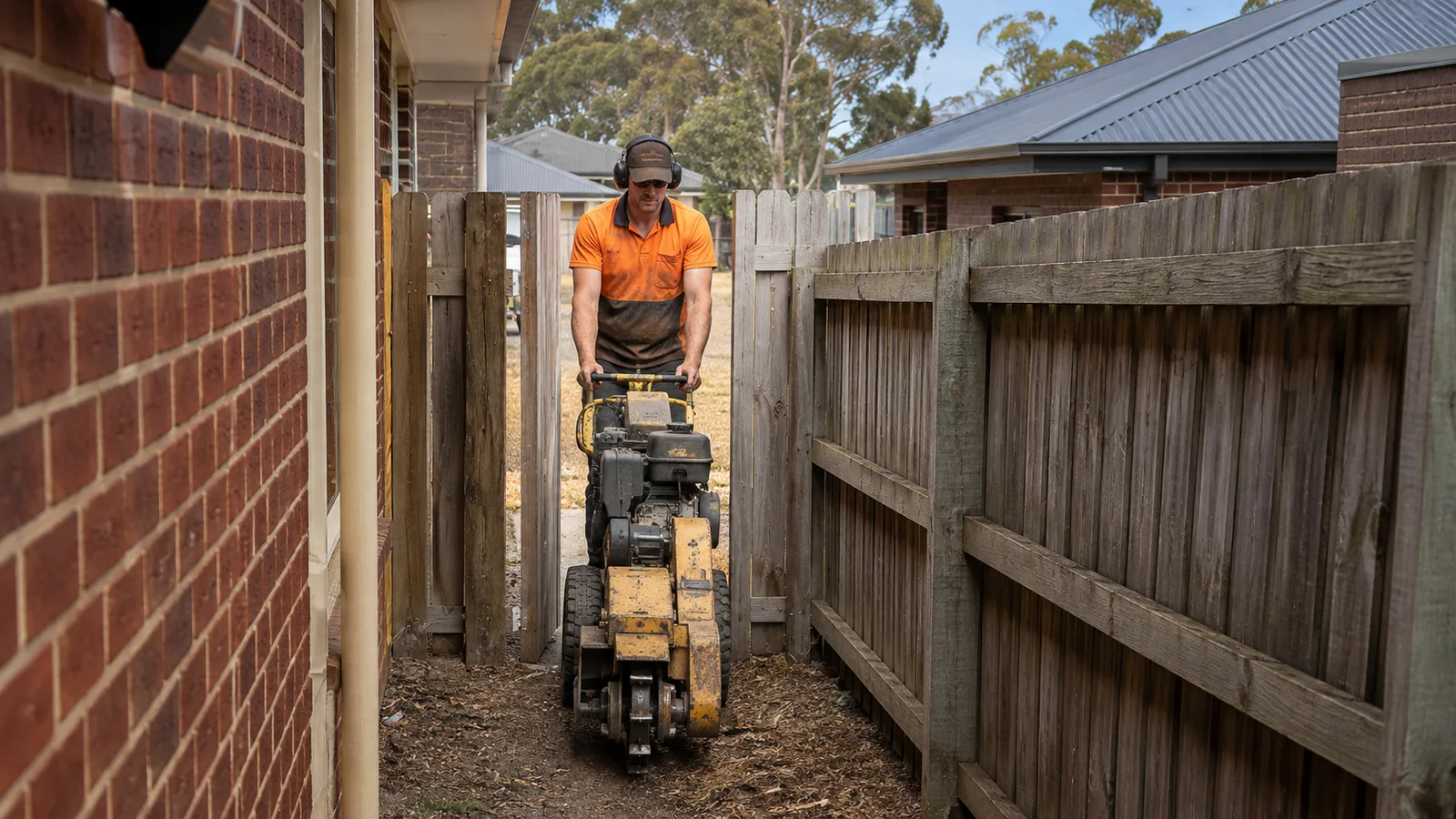
The pinch points that catch people out.
These are the five obstructions that turn an 880mm gate into a 690mm passage. All of them sit past the gate, which is why the gate measurement gives false confidence.
| Obstruction | Typical loss of width | What to do about it |
|---|---|---|
| Gas or water meter box | 100 to 200mm off the wall side | Nothing, it is fixed. Measure from its face to the fence, not from the wall |
| Rainwater tank | Often the whole passage | Check whether there is a second route around the other side of the house |
| Air-conditioning condenser | 300 to 500mm, sometimes at knee height on a bracket | A bracket-mounted unit can often be passed under. A ground-mounted one cannot |
| Retaining wall or garden edge step | Width plus a change in level | A step over 150mm needs a ramp or boards, not just clearance |
| Gate that opens onto a step | Gate only swings 60 degrees | Lift the leaf off its hinges, which is faster than it sounds |
How to measure it in two minutes: walk from the kerb to the stump with a tape, stop at every point where the path narrows, write each number down, and send us the smallest one along with a photo taken from the street looking down the side of the house. That single figure decides the machine, the price and whether the job is bookable, and it saves a wasted trip for both of us. There is more on machine sizing in backyard access and machine size.
What Officer, Arena, Cardinia Lakes and Heritage Springs are actually like.
The newer estates through Officer and the Pakenham growth corridor are built to a fairly consistent pattern, and that pattern is good news for access. Blocks run 350 to 500 square metres, houses sit close to at least one side boundary, and the standard build gives you one usable side passage and a single gate. That passage is normally 900mm to 1.2 metres of nominal width, which the machine clears comfortably, so the answer on most of these blocks is yes.
Where they catch you is the second half of the equation. Because the passage is narrow to begin with, everything the builder or the owner has hung on the wall matters. Condensers get mounted in side passages because there is nowhere else to put them. Rainwater tanks on the smaller lots go down the side for the same reason. And the ground itself is often the developer's reworked clay with imported fill over it, so it can be soft after rain in a way that established Pakenham ground is not.
The stumps in these estates also tend to be a particular type. Developer-planted street and garden trees are now around fifteen years old, so we see a lot of ornamental pears, bottlebrush and young gums in the 250 to 500mm band, which is comfortable work for the narrow machine. What we do not see much of here is the 900mm-plus paddock gum, which is a hills and acreage stump and needs the room to match. The pricing bands for both are on the 2026 price guide.
Four options, and what each one really costs.
Sometimes the narrowest point is 600mm and there is no second route. There are four honest answers and we will tell you which one applies rather than turning up and charging you for the discovery.
- Take a few palings out. Removing two or three palings from a timber fence and screwing them back afterwards is roughly half an hour each way. On a job where the alternative is an hour of extra machine time or no job at all, this is very often the cheapest answer, and it is the one we suggest most.
- Lift the gate leaf off. Where the gate itself is the restriction rather than what is past it, pulling the leaf off its hinges takes a few minutes and costs nothing. Worth checking before assuming the passage is unusable.
- Hand dig it. A 300mm stump dug out by hand with a mattock and a bar is two to four hours of work, and it climbs steeply with diameter. On a small stump it is a defensible choice. On anything over about 400mm it costs more than machine grinding would have, and it is not something we would recommend paying for.
- Lift the machine in. Craning or hiabing a grinder over a house or a wall is done on commercial sites. On a residential stump the lift alone typically costs several times the grinding, so it almost never makes sense unless a crane is already booked for something else.
There is a fifth option that people rarely raise and we will: leave it. A stump in a rear corner that nothing is being built on costs you nothing to leave and will break down on its own over ten to twenty years. If the reason for removing it is that a slab or a shed is going over the spot, that is a different job entirely and the root ball has to come out, which is covered under full stump removal.
Boards, one-sided stumps and the last 50mm.
Getting in is half of it. Two things then decide how the job runs in a tight yard.
The first is what the machine travels over. A tracked grinder spreads its weight tolerably across grass, and on dry ground it leaves track marks that rake out. It does not spread its weight in any useful way across pavers laid on a sand bed, which have nothing structural underneath them, or across decking, where the load lands between the joists instead of on them. Where the only route crosses either, we lay boards and walk across those. It takes a few minutes and it is the difference between an intact path and a rocked paver you notice a fortnight later. Wet clay is the other case for boards, and on the Pakenham flats in winter there are weeks where rescheduling gives a visibly better result than pushing through.
The second is which side of the stump you can stand on. The cutting wheel sweeps across the face of the stump rather than boring into it, so a stump with a metre of clear ground all around it can be attacked from every angle and finishes fast. A stump hard against a wall or a boundary fence can only be worked from the open side, which means the operator is reaching across and nibbling at the far face, and the same stump takes noticeably longer. The last 30 to 50mm against brickwork or a concrete footing frequently cannot be reached by machine at all without risking the structure, so it gets finished by hand or deliberately left below grade where it does no harm. Where a fence is on that side, pulling one paling is usually cheaper than the extra machine time, which is the same trade-off as the access question.
Services still get checked in a tight yard, and if anything the risk is higher there, because irrigation, garden lighting and a private power run to a shed all tend to follow the same side passage the machine is using. A free Before You Dig Australia enquiry goes in on anything near a boundary, meter or service run. Once the machine is in position, the grinding itself works exactly as it does anywhere else, which is set out under stump grinding.
Questions about tight access.
What width does a narrow-access stump grinder need?
760mm of clear width, measured at the narrowest point of the whole route in. That clears a standard single side gate on almost every estate block through Officer, Cardinia Lakes, Heritage Springs and the newer Pakenham developments, which is why most backyard stumps in this part of the shire are reachable without touching a fence. Height matters as well, though it catches people out far less often, and the machine needs enough headroom under a carport beam, a pergola or a low branch. If you can send one measurement before we quote, make it the narrowest gap on the path from the street to the stump.
How do I measure the access properly?
Walk the route the machine has to take, from the kerb to the stump, and measure every point where something narrows it. The gate posts are almost never the answer people think they are, because the real pinch is usually a metre or two past them: a meter box standing proud of the wall, a rainwater tank, an air-conditioning condenser on a bracket, a step down beside a retaining wall, or a gate leaf that only opens to 60 degrees before it hits a step. Take the smallest number you find and send that one. A single accurate figure prevents a wasted call-out.
What happens if the machine physically cannot get in?
There are four honest options and we will tell you which one makes sense. Taking two or three palings out of a side fence and reinstating them is around half an hour each way and is very often cheaper than any alternative. Lifting a gate leaf off its hinges is quicker again where the gap behind it is wide enough. Hand digging is real work, two to four hours for a 300mm stump, so it costs more than machine grinding and only stacks up on small stumps. Craning a machine over a house is rarely worth it on a residential job. Leaving the stump is a legitimate answer too.
Can the machine be driven over pavers, decking or a sand-set path?
Not without boards under it. A tracked grinder spreads its weight reasonably well across turf, but pavers on a sand bed have no structural support underneath, so a track edge can rock one paver, sink a corner or crack a slate. Decking is worse, since the load lands between joists rather than on them. Where the only route in crosses paving or decking we lay boards and walk the machine across them, which spreads the load over a much larger area and takes a few minutes to set up. If boards will not work on your surface we will say so before booking, not on the day.
Does a tight-access job cost more than an open one?
Usually yes, and the reason is time rather than difficulty. Walking a machine down a 900mm side passage, setting debris screens where there is no room to stand back, and grinding a stump that can only be approached from one side all add time to a job whose price is largely time. As a rough guide, a stump the machine can circle freely is often half the cutting time of the same stump wedged into a corner with a fence on two sides. It is priced honestly at quote stage rather than added on afterwards, which is why we ask about access on the phone.
Tight-access jobs across the Cardinia Shire.
Measure the narrowest gap and send us that one number.
With the stump diameter, the tightest measurement on the route in and one photo down the side of the house, we can tell you whether it is bookable and what it costs without anyone driving out.