Stump grinding in Pakenham.
A carbide wheel spinning at a couple of thousand rpm, sweeping across the stump and taking it down a few millimetres at a time until the whole thing is below grade. It is the right answer for about nine stump jobs in ten, and the only decision that really matters is how deep you want it to go.
How a stump grinder works.
The business end is a steel wheel around 400 to 600mm across, studded with replaceable carbide teeth. It does not bore into the stump like a drill. It sweeps sideways across the face, shaving off a layer, drops a fraction, and sweeps back. Watching it, the stump seems to disappear from the top down in flat passes, and the material coming off is a coarse chip and soil mix rather than sawdust.
That sweeping action is why access matters more than size. A machine that can walk around a stump cuts from every angle and finishes fast. The same stump against a fence can only be swept from one side, so the operator ends up nibbling at the far face, and a forty-minute job becomes ninety. When we ask on the phone how much room there is around the stump, that is what we are pricing.
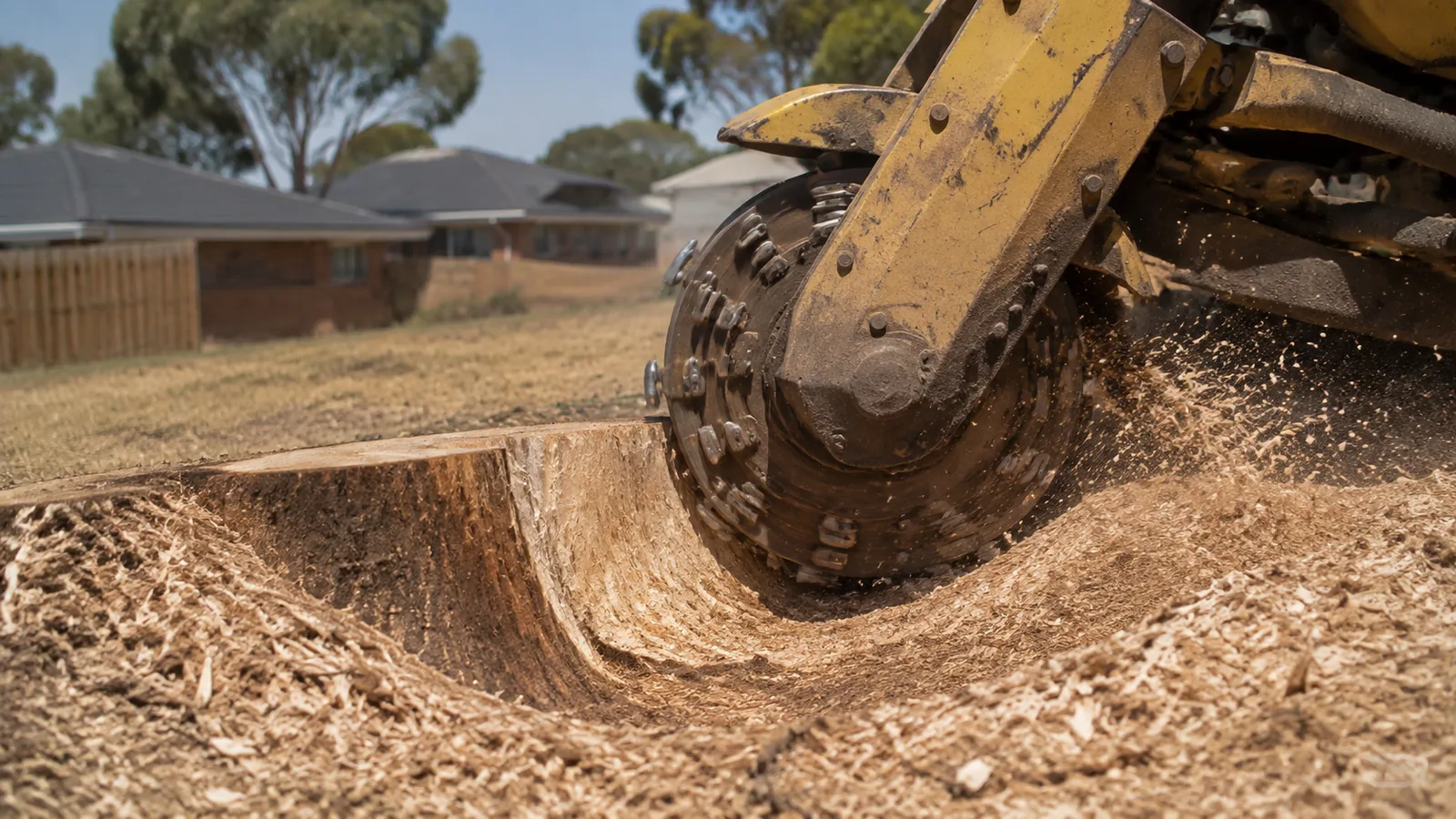
The other thing the sweep explains is the volume of material. A ground stump produces roughly two to three times its own volume in chip, because the wood fluffs as it is cut and picks up soil on the way. People are consistently surprised by the size of the heap. What happens to it is a decision worth making before the job rather than after, and it is covered properly in what to do with stump grindings.
How deep, and why it depends entirely on you.
There is no standard depth. There is only the depth that suits whatever is going on that spot next, and getting this wrong is the cause of nearly every complaint about stump grinding.
| What is going on the spot | Grind depth | Why |
|---|---|---|
| Lawn or turf | 150mm | Turf roots do not go deeper. Anything more is money spent moving dirt for no benefit. |
| Garden bed, new shrub | 250 - 300mm | New plants need clean root room, and shallow chip robs nitrogen from anything trying to establish in it. |
| New tree in the same hole | 300mm+ and spoil removed | Replanting into raw grindings is the single most common cause of a replacement tree failing. |
| Pavers, sand-set path, decking | 300mm plus surface roots | It is the roots that lift pavers, not the stump. Grinding the stump alone solves nothing here. |
| Concrete slab, shed, extension, footing | Do not grind at all | A rotting root plate under concrete becomes a void, and a void becomes a crack. Excavate instead. |
| Fence line or retaining wall | Depends on the post depth | Posts have to go somewhere solid. If a post lands on the old root plate it will move. |
If you take one thing from this page: tell whoever quotes you what is going on the spot afterwards. A contractor who does not ask is going to grind to whatever depth is quick, and on a job where a slab or paving is coming, quick is the wrong answer. There is a full breakdown in how deep to grind a stump.
What Cardinia soil does to a stump job.
The shire is not one soil type and the difference shows up in the price. On the Pakenham and Officer flats you are mostly into heavy grey and brown clay, which holds water. In winter that ground goes greasy, a tracked machine marks it badly, and grindings mixed into wet clay make a sticky mess that does not rake nicely. We will still do the work, but there are weeks where booking a fortnight later gives you a visibly better result.
Down towards Koo Wee Rup and the old swamp country the ground turns to peat and sand. Peat is soft and easy cutting, but it slumps afterwards, so a hole backfilled with grindings there will sink noticeably more than the same hole in clay. Sand is the opposite problem: it is abrasive, and grit packed into the bark of an old stump blunts carbide teeth faster than the timber ever does.
Climb north into Pakenham Upper and Beaconsfield Upper and you hit slope and rock. Steep ground limits which machine can safely work, and a buried lump of basalt hidden inside a root flare will stop a job dead. On the hills we quote with that possibility named up front rather than pretending it will not happen.
When we tell you not to grind.
There are four situations where grinding is either the wrong tool or a waste of your money, and we would rather say so at the quote.
- Something is being built on the spot. Slab, shed, footing, pool shell, retaining wall. The root plate has to come out, which means excavation, not grinding.
- The real problem is the roots. If paving is lifting or a driveway is humping, the stump is not what is doing it. See surface root removal.
- The stump is not in anyone's way. A stump in a back corner of a paddock or a rear garden bed costs you nothing to leave, and will break down on its own over ten to twenty years while providing habitat. Keeping your money is a legitimate option and we will tell you so.
- The tree is still standing. Felling is separate work, and in Cardinia Shire a living tree with a trunk circumference of 110cm or more at 1.4m is covered by the Tree Protection Local Law, as are indigenous remnants at any size. That permit needs sorting before anyone starts cutting.
Questions about grinding.
How long does it take to grind a stump?
Under 300mm across is 20 to 30 minutes of cutting. 300 to 600mm is 30 to 60 minutes. Over 600mm runs one to two hours, and past 900mm or multi-stem can be a half day. Add 15 to 20 minutes each way for walking the machine in, setting screens and raking off. Access changes these numbers more than size does.
Does stump grinding kill the roots?
It ends any chance of the tree regrowing, which is what the question usually means, but the roots stay in the ground and break down over roughly five to fifteen years depending on species and soil. That is harmless under lawn and garden and unacceptable under a slab. Watch the suckering species, mainly poplar, some willows, robinia and a few wattles, which can push shoots from roots metres away even after the stump is gone.
Will grinding damage my lawn or paving?
On dry ground a tracked machine leaves little more than track marks that rake out. Wet clay is the exception and after heavy rain we would rather reschedule than leave ruts. We do not run tracked machines over unsupported pavers or sand-set paths; where that is the only route we lay boards. Debris screens keep the chip off render, glass and cars, and they matter more than people expect.
Can you grind a stump that is right against a fence or wall?
Usually, with two caveats. The wheel has to sweep across the face, so a stump hard against something solid can only be worked from the open side, which is slower and dearer. And the last 30 to 50mm against brickwork or a footing often cannot be reached safely by machine, so it is finished by hand or deliberately left. Pulling one fence paling is frequently cheaper than the extra machine time, and we will say so rather than charging you for the awkwardness.
Across the Cardinia Shire.
One stump or forty, same fixed-price approach.
Send the diameter across the cut face and tell us what is going on the spot afterwards. That is enough for a firm number on most residential jobs.