Gum, palm, pine and the rest: species changes the job.
Two stumps the same diameter can be an hour apart and a couple of hundred dollars apart, purely because of what the tree was. Hardness, root habit and how the material behaves as it is cut all vary enormously. This is what each of the common Cardinia Shire species means for the machine, the time and the price.
Diameter sets the ballpark. Species sets where in it you land.
Stump grinding is priced off the diameter at ground level, roughly $3.00 to $4.50 per centimetre across Melbourne, and that band is wide for a reason. Species decides where inside it a particular stump sits, and occasionally it pushes a job out of the band entirely.
Three things do the work. Hardness determines how many passes the wheel needs and how fast the carbide teeth go blunt, and blunt teeth cost money as well as time. Root habit determines how much ground area you are actually cutting, which on a wide-flared tree is several times the trunk diameter. And the behaviour of the material as it comes off determines whether the job runs continuously or stops repeatedly, which is the whole story with palms.
What follows is the practical version for the species you actually get in this shire, rather than a botanical list. The full pricing structure sits on the 2026 price guide, and the depth question, which is separate from species and matters more, is on how deep to grind a stump.
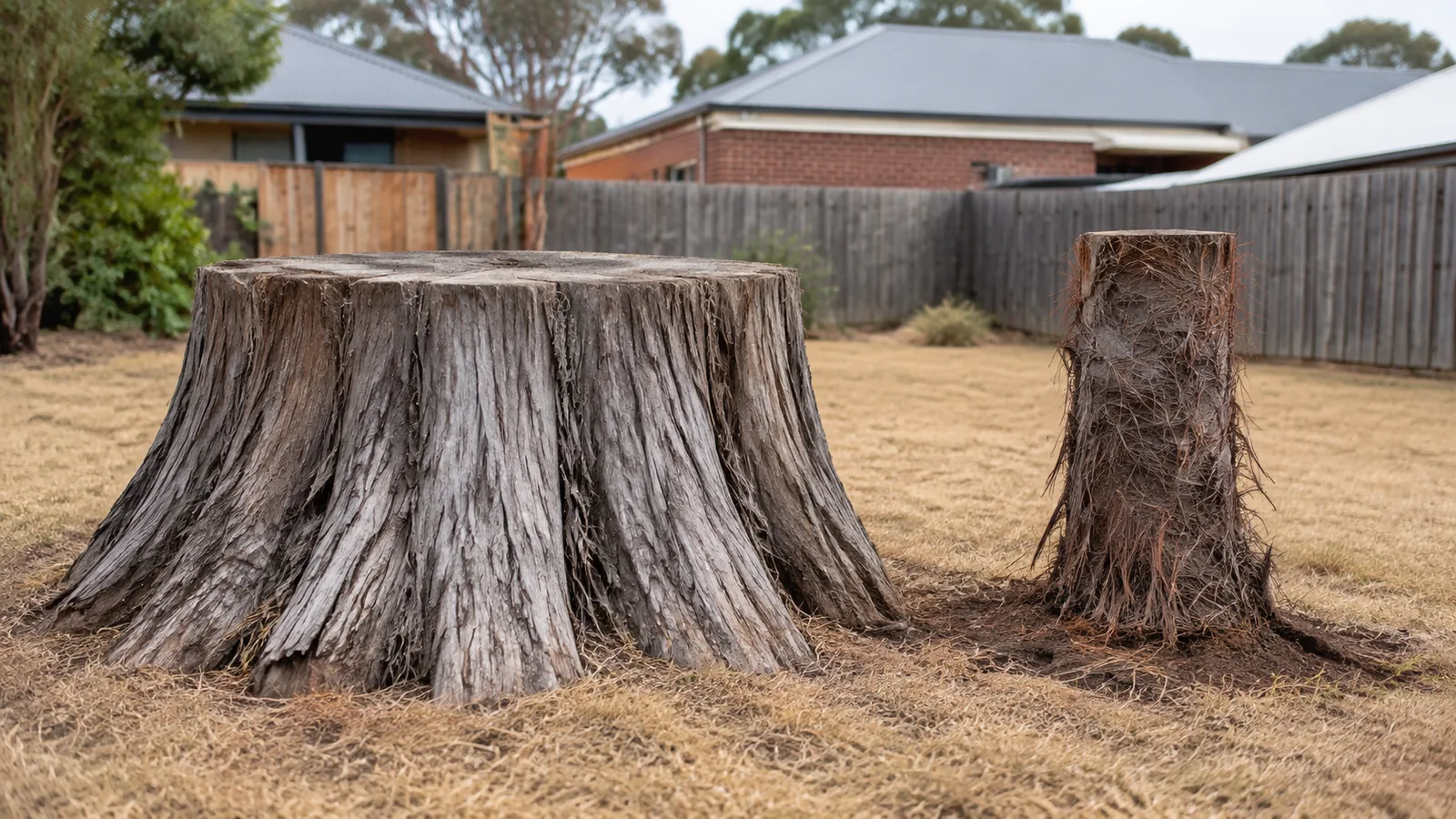
Eucalypts and gums.
Most stumps in this shire are gum. Estate plantings that are now fifteen to twenty years old, remnant paddock trees left standing when the farmland was subdivided, and large indigenous specimens on the older and semi-rural blocks.
Eucalypt timber is dense and hard, and it cuts slowly. More significant than the hardness itself is the root flare. Gums characteristically spread wide and low at the base, so a trunk measuring 700mm across can present a metre and a half of buttressed root at ground level, and every bit of that has to be ground if the ground is going back to lawn or garden. The area being cut is the cost, not the trunk.
Then there is the bark. Deeply fissured eucalypt bark collects grit and small stones, and grit is harder on carbide teeth than the timber ever is. A stump that has sat for a year with soil washed into the bark and around the flare will blunt a set of teeth noticeably faster than a freshly cut one. This is why contractors ask how long the stump has been there, and it is a genuine cost input rather than small talk.
The biggest jobs in the shire are the old paddock sugar gums (Eucalyptus cladocalyx) planted as farm shelter, and remnant river red gums (Eucalyptus camaldulensis) along the watercourses and the flats. Both routinely sit in the top band above $800, and both are quoted on site. River red gum is also one of the indigenous species protected at any size under the Cardinia Shire Tree Protection Local Law, so if the tree is still standing, that permit question comes first. Once it is cut, grinding the stump is not normally a permit matter.
Cypress and conifer shelter belts.
Long rows of cypress run along old boundaries all through Nar Nar Goon, out past Tynong, and across the flat country towards Koo Wee Rup. They were planted as windbreaks for orchards and dairy paddocks, they are now sixty to ninety years old, and subdivision has left plenty of them sitting on residential titles.
Old cypress timber is hard, and it is resinous. The resin gums up the cutting face and the chip is stringy rather than clean, which slows the wheel more than the density alone would suggest. Individually a cypress stump prices similarly to a gum of the same size, occasionally a bit above it.
The thing that actually changes the economics is the row. Cypress was almost never planted as a single tree, so a cypress job is usually eight or twenty or forty stumps in a line rather than one. That is a per-day job, not a per-stump job, at roughly $1,400 to $2,600 per day, and it works out far cheaper per stump than pricing them individually. Anything of that shape belongs on block and boundary clearing rather than a single stump quote.
Radiata pine.
Pinus radiata is the pine you find here, in old shelter rows, in the odd 1970s garden planting that outgrew its spot, and as remnants of plantation edges. It is a softwood and it cuts noticeably faster than any eucalypt. Teeth last longer, the chip comes off cleanly, and per centimetre of diameter it sits at the lower end of the price band.
The complication is size and shape. Pines get big, and they carry a broad shallow root plate rather than a deep root system, so the plate spreads out just under the surface over a wide area. That is easy cutting but there is a lot of it, and it means a pine stump often needs more ground worked than a gum of the same trunk diameter even though each pass is quicker.
The shallow plate has one useful consequence: pine is a good candidate for full excavation where something is being built on the spot, because the plate lifts more readily than a deep gum flare does. That decision, grind or excavate, is set out on grinding versus full removal.
Palms.
Palms are a completely different material and they behave nothing like a tree stump. A palm is not true wood. It has no annual rings and no heartwood, and the trunk is a mass of vascular fibre bound in softer tissue. Most species have no true taproot either, just a dense mass of fine adventitious roots close to the base.
Cutting is fast and wet. The wheel goes through the fibre easily, but instead of throwing clear as chip the long wet fibre packs around the wheel and into the guard, so the operator stops repeatedly to clear it. A palm can take as long as a much harder stump purely because of the stopping and starting, and it makes a heavier, wetter, less useful spoil heap than a wood stump does. The spoil question is covered on what to do with stump grindings, and palm fibre is at the poor end of it.
The offsetting good news is the root ball. It is far smaller and more contained than people expect, often not much wider than the trunk. That makes a palm one of the few stumps where digging it out whole is genuinely the better method, and in the sandy ground down around Koo Wee Rup a modest palm can be excavated in less time than it would take to grind and clear the fibre. Where the hole is going to be built on or planted, digging is usually the answer.
Willow and poplar sucker, and grinding does not stop them.
This is the single most important species point on the page, because it is the one where a customer's expectation and the physical reality diverge.
Poplars and several willows reproduce vegetatively from the root system. Cut the tree down, grind the stump out completely, and new shoots still push up from roots that may be several metres away, along the run of the root system, sometimes on the far side of a fence. Grinding removes the stump and the top of the root plate. It does not touch the roots that are producing the suckers, and nothing that happens at the stump location affects them.
Around here that is a live issue along the Koo Wee Rup drains, where both were planted heavily for bank stabilisation on the old swamp country and both have spread since. Robinia and a few wattles do the same thing to a lesser degree. A root system running that far out from the trunk is also a reason to check what else is in the ground first, which is set out on underground services before stump grinding.
The honest advice is to expect suckers for a season or two and to plan for them. Mowing them off repeatedly works, because every shoot removed drains a little more stored energy from the root system and the response weakens each time. Chemical treatment of the shoots is more direct. Either way, the timber itself is soft and the grinding is quick and cheap, so the grinding is rarely the expensive part of a willow or poplar. The suckering is.
What to ask a contractor: if you tell someone you have a poplar and they say grinding will finish it, that is wrong. It is the clearest test of whether the person quoting has actually done this work. Every root system left in the ground breaks down over roughly five to fifteen years, but a suckering species stays active the whole time.
Small ornamentals, and the peppercorn that is not small.
Fruit trees, ornamental pear (Pyrus calleryana and its cultivars, which are everywhere on the estates), small wattles and silver birch (Betula pendula) are all soft, small and quick. Twenty to thirty minutes of cutting, a modest root plate, and almost all of them land at the minimum call-out of $180 to $250. Since the call-out is what you are really paying for, doing three or four in one booking rather than one at a time saves real money, at 30 to 50 per cent less for each additional stump on the same visit.
Peppercorn (Schinus molle) is the one that catches people out. They stand around old farmhouses right across the shire, they look like a friendly shade tree, and at ground level they are enormous. A peppercorn develops a huge low spreading flare, often multi-stemmed, and the ground area to be cut can be three or four times what the trunk suggests when you are looking at it from the back door. They routinely price like a large gum. If you have one, send a photo with a tape or a shovel in the frame for scale, because the number people give over the phone for a peppercorn is almost always low.
The species table.
| Species | Hardness | Root habit | Job difficulty | Watch for |
|---|---|---|---|---|
| Eucalypts and gums | Hard to very hard | Wide low flare, often buttressed | High. Above the price band for the diameter | Grit in fissured bark blunts teeth faster than the timber does |
| Paddock sugar gum, river red gum | Very hard | Very wide flare, sometimes 2m at ground level | Highest in the shire. Site quote only | River red gum is protected at any size while still standing |
| Cypress and conifer belts | Hard, resinous | Moderate, dense | High per stump, but usually a per-day row job | Resin gums the cutting face. Price the row, not the stump |
| Radiata pine | Soft | Broad shallow root plate | Moderate. Fast cutting over a large area | Big plate means more ground worked than the trunk suggests |
| Palms | Soft, fibrous, wet | Compact ball of fine roots, no true taproot | Moderate. Fast cutting, slow clearing | Fibre clogs the machine. Often cheaper to dig out whole |
| Willow and poplar | Soft | Wide, shallow, and it suckers | Low to grind, ongoing afterwards | Shoots come up metres away. Grinding does not end it |
| Fruit, ornamental pear, wattle, silver birch | Soft | Small and shallow | Low. Usually the call-out minimum | Book several at once. Extra stumps are 30 to 50 per cent less each |
| Peppercorn | Moderate | Huge low flare, frequently multi-stem | High, and consistently underestimated | Ground area is several times the trunk diameter |
How to use this: measure the widest point of the cut face, find your band on the price guide, then move up within the band for gum, cypress and peppercorn and down for pine, palm, willow and small ornamentals. That gets most people within about twenty per cent before they ring anyone. If the stump is also in a tight spot, access changes the number more than species does, which is set out on measuring backyard access.
Questions about species.
Why does a gum stump cost more than a pine stump the same size?
Because price follows tooth wear and cutting time, not just diameter. Eucalypt timber is dense and hard, so the wheel takes more passes and the carbide teeth blunt several times faster than in radiata pine. Gums also carry a very wide root flare, so the ground area being cut is much larger than the trunk diameter suggests. Add the grit that collects in deeply fissured gum bark, which is harder on teeth than the timber itself, and a 600mm gum can take twice as long as a 600mm pine and consume a set of teeth doing it.
Are palm stumps easy to remove?
They cut fast and they make a mess. A palm is not true wood, it is a fibrous mass with no annual rings, and most species have no true taproot. The wheel goes through it quickly and wet, but the long wet fibre packs into the machine rather than throwing clear like chip, so the job stops and starts. The upside is that the root spread is far smaller than people expect, usually a dense ball of fine roots rather than a wide flare, so a palm is often easier and cheaper to dig out whole than to grind, particularly in the sandy ground down towards Koo Wee Rup.
Will grinding stop a willow or poplar coming back?
Not on its own. Poplars and several willows sucker from the root system, so new shoots push up from roots that can be metres from where the stump was, and grinding the stump does nothing to those roots. It is a real issue along the Koo Wee Rup drains where both were planted heavily. Expect suckers for a season or two and plan to deal with them by mowing them off repeatedly or treating them, because every shoot removed drains a little more stored energy from the root system. Anyone who tells you grinding ends a poplar is guessing.
What is the most expensive kind of stump to grind around Pakenham?
Large old paddock sugar gums and remnant river red gums, followed closely by old peppercorns and mature cypress. All four share the same expensive trait, a huge low root flare that spreads the cutting area well beyond the trunk. A river red gum measuring 900mm across the trunk can present two metres of buttressed root at ground level, so you are grinding four or five times the area. These sit in the top price band, above $800 and sometimes well past it, and they are quoted on site rather than off a photo.
Which stumps are cheap to grind?
Fruit trees, ornamental pear, silver birch, small wattles and most ornamental shrubs. They are small, the timber is soft, the root plate is modest, and the whole job is usually twenty to thirty minutes of cutting. Almost all land at the minimum call-out of $180 to $250, which means the second and third stump on the same visit cost far less each because the travel and set-up are already paid for. If you have three or four small stumps, do them in one booking rather than one at a time.
Tell us the species and the diameter and we will tell you the price.
If you are not sure what the tree was, a photo of the cut face is usually enough to identify it. Pakenham, Officer, Beaconsfield, Nar Nar Goon, Pakenham Upper and Koo Wee Rup.