Building a shed or extension where a stump used to be.
There is one clear answer on this page and no hedging around it. If a slab, a footing or any permanent structure is going over the spot, do not grind the stump. Excavate it, take the root plate with it, and backfill properly. It costs more, it is not optional, and the reason is straightforward.
Rotting timber becomes a void, and a void becomes a crack.
A stump grinder removes the stump and the top of the root plate, typically 150 to 300mm below ground level. Below that line, the main root plate and every lateral root stays exactly where it is. Under a lawn or a garden bed that is the correct and cheap answer, because buried timber breaking down slowly under grass causes nobody any trouble.
Put a concrete slab over it and the same process turns into a structural problem. The timber loses volume as it decays. The soil above it has nowhere to go but down, so the ground under one part of your slab settles while the ground around it does not. The slab is now spanning a soft or empty patch it was never designed to span. Concrete carries compression well and tension badly, so it cracks across the unsupported section, and on a shed floor that shows up as a crack you can put a coin in, while on a garage or an extension it can show up in the walls above.
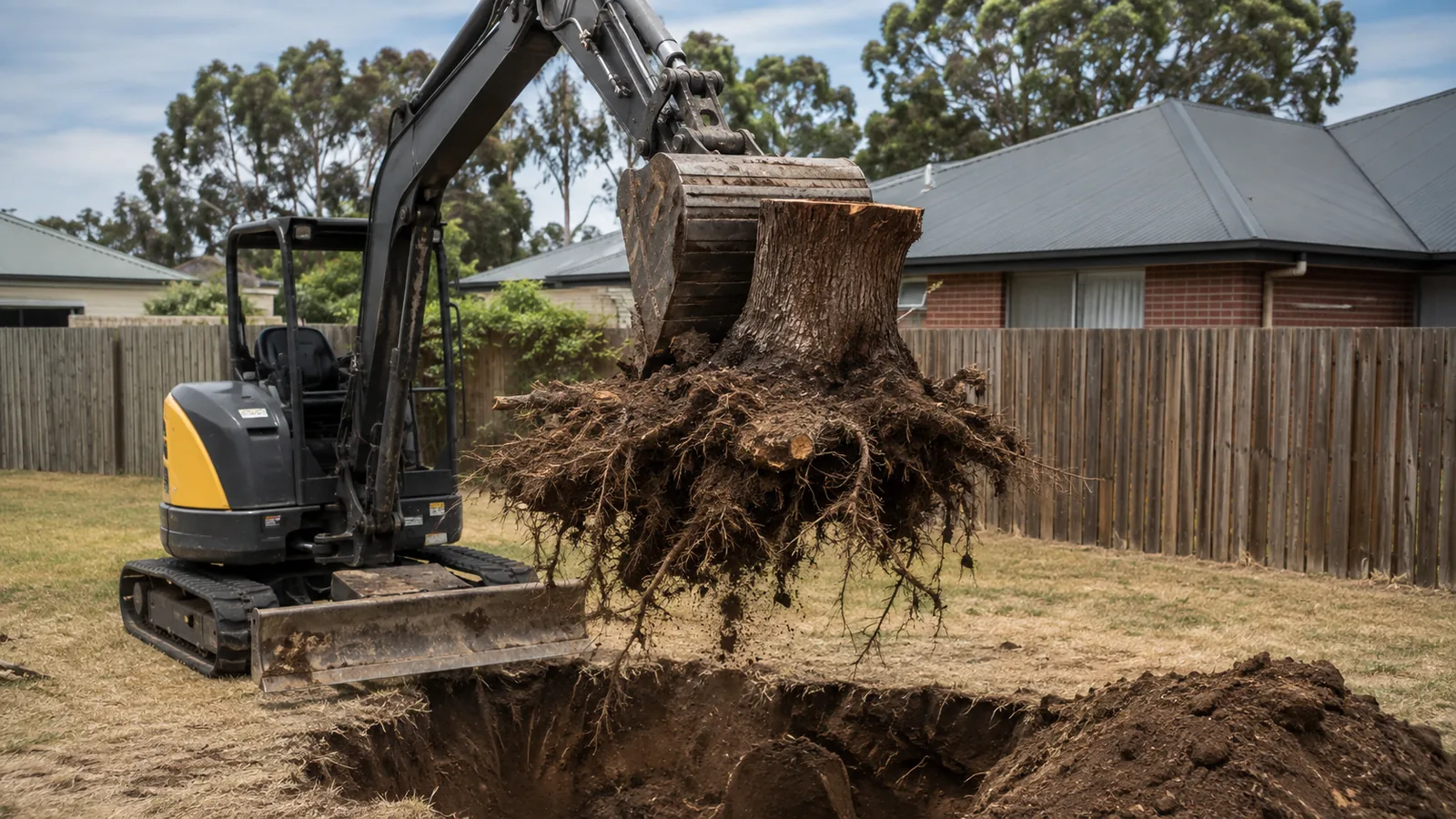
The timing is the trap. This does not happen during construction, and it does not happen in the first year. Root timber breaks down over roughly five to fifteen years, and the settlement follows the decay, so the crack tends to arrive somewhere between year three and year ten. That is after handover, after the defects period, and usually after everyone involved has forgotten there was a tree there. It becomes your repair bill and your problem at resale, and the cost of dealing with a cracked slab is many times the cost of excavating the stump before the pour. The wider depth-by-end-use logic is set out in how deep to grind a stump.
What is going on top changes the requirement.
A garden shed on a small pad and a habitable extension on an engineered slab are different jobs with different tolerances. Work out which one you have before you price anything.
| What you are building | Stump treatment | Why |
|---|---|---|
| Shed on a concrete slab | Excavate the stump and root plate, compacted backfill | The slab is unreinforced or lightly reinforced and settles into any void beneath it |
| Shed on screw piles or isolated footings | Excavate where each pile or footing lands, at minimum | A pile bearing on decaying timber is bearing on nothing in ten years. Piles between the roots may be acceptable, and that is the engineer's call, not ours |
| Garage or carport slab | Excavate | Vehicle loads over a settling patch crack a slab faster than foot traffic does |
| Habitable extension | Excavate, and expect the engineer to want the backfill specified and inspected | Footings, wall loads and internal finishes all move with the slab. This is the least forgiving case on the list |
| Timber deck on stumps or piers | Excavate where piers land, keep buried timber away from bearers | Pier settlement shows up as a sloping deck, and buried decaying timber under a deck is worth avoiding for pest reasons as well |
| Paving, sand-set path | Grinding to 300mm plus surface roots is usually acceptable | Segmental paving tolerates movement and can be lifted and reset. This is the one case on the list where grinding is defensible |
The screw pile line is worth reading twice. People assume that because a shed is on piles rather than a slab, the stump underneath stops mattering. Sometimes that is true and it is not your decision to make. Ask the engineer or the shed supplier where the piles land and what they are bearing on. If a pile is going through the old root plate, the timber has to come out of that location regardless of what happens elsewhere on the pad.
Backfill is as important as the digging.
Excavating a 600mm stump and its root plate leaves a hole a couple of metres across and up to a metre deep. What goes back into that hole determines whether you have solved the problem or replaced one settlement mechanism with another. A slab over poorly compacted backfill settles just as reliably as a slab over rotting timber, and it does it faster.
The correct approach is engineered fill, placed and compacted in layers. Clean granular material or approved site soil, brought in at roughly 200 to 300mm at a time, compacted with a plate or a roller before the next layer goes on. Tipping the spoil back in loose and letting it find its own level is not the same thing and will not perform like it. On an engineered slab your builder or the engineer will specify the material and may want the compaction confirmed before the pour, so ask them what they need before the hole is filled rather than after.
Grindings absolutely do not go back into a hole under a slab. Beyond the compaction problem, they are organic material that is still decomposing, which recreates exactly the void you paid to eliminate. Where the grindings from an ordinary garden job can and should go is covered in what to do with stump grindings. On a build site they go off the property.
The stump comes out early, not late.
The order of operations on site is worth getting right, because doing this job out of sequence costs money on every subsequent trade.
Stump and root plate out
While the site is still open and a machine can reach the spot from any direction. This is also when a services enquiry belongs, and a free Before You Dig Australia lodgement takes minutes and covers you for the deeper digging that excavation involves.
Backfill and compact in layers
To whatever the builder or engineer specifies, confirmed before it is covered over. Filling a hole is easy to do badly and impossible to inspect once the pad is cut.
Level the pad and set out footings
Now the levels mean something, because the ground under them is not going to drop by 150mm over the next decade. Doing this before the stump comes out means recutting the pad afterwards.
Services, then pour
Trenching for power, water and drainage goes in after the ground has been settled and levelled. Excavating a stump next to conduit that is already in the ground is slow, nervous work and it is entirely avoidable.
The version of this that goes wrong is familiar on the newer estates through Officer and the Pakenham growth corridor, where a shed or a studio goes up on a block that still has a remnant paddock gum or a cypress from the old windrow in the corner. The pad gets cut, the slab gets set out, and only then does somebody notice the stump inside the footprint. At that point the fix means recutting a levelled pad and recompacting, which costs several times what it would have cost in week one. On the acreage blocks around Nar Nar Goon the same thing happens with old shelter belt stumps that were bulldozed flat decades ago and are barely visible until a machine hits one.
Excavation is two to four times grinding, and it is not the place to save.
Full excavation runs roughly two to four times the grinding price for the same stump. A 600mm stump that would be $450 to $800 to grind is a materially bigger number to dig out, because there is an excavator on site, a large hole, spoil to remove and backfill to bring in and compact. Current rates for both methods sit on the 2026 price guide, and the method itself is described on full stump removal.
Here is the part worth being blunt about. When you get three quotes for a stump inside a shed footprint, the cheapest one is frequently the cheapest because it is a grinding quote. It is a real price for a real service that is the wrong service for your job, and accepting it feels like saving $600 right up until the slab cracks in year six. When you ring for a price, say what is going over the spot. Any contractor worth using will change their quote when they hear the word slab, and a contractor who does not ask what the ground is for is not pricing your job, they are pricing a stump.
Roots running out beyond the footprint are a separate question and often matter on a build. Where a driveway, a crossover or a paved area is going in near an established tree that is staying, the roots under it need dealing with independently of the stump, and that is covered in tree roots lifting a driveway.
The council question is about the tree, not the stump.
In Cardinia Shire the Tree Protection Local Law covers living trees rather than dead stumps, so removing or excavating a stump that has already been cut is not normally a permit matter in itself. Two things can still catch a build out.
The first is that if the tree is still standing, the permit question applies before anyone starts cutting, and the Cardinia thresholds catch far more trees than owners expect. The scope, the protected indigenous species and the overlays that sit on top of the Local Law are set out on multiple stumps and block clearing. On a build site the practical consequence is a sequencing one: get the standing-tree approvals resolved before you have a machine booked, because a permit that comes back with conditions can move your whole start date.
The second is that a build with a planning permit can carry its own tree and vegetation conditions, including trees to be retained and root zones to be protected during construction. Those conditions attach to the permit and are enforced separately from the Local Law. Read them before you book any machine onto the site, and check the current position with Cardinia Shire, because fees and processes change and anything you read on a website including this one can be out of date.
Questions about building over a stump.
Can I just grind the stump if a shed slab is going over it?
No. Grinding takes the stump and the top of the root plate, usually 150 to 300mm below grade, and leaves the rest of the root system in the ground. Under lawn that is harmless. Under a slab the buried timber keeps rotting, loses volume, and the soil above drops into the space, so the slab ends up bridging a void it was never designed to span. Concrete is weak in tension and cracks across the unsupported section. If anything permanent is going on the spot, the stump and root plate have to be excavated and the hole backfilled properly.
How long before a rotting stump under a slab causes a problem?
Years rather than months, which is why it keeps happening. Buried root timber breaks down over roughly five to fifteen years depending on species and soil, and settlement follows the decay. The slab is usually fine on handover, fine at the end of the defects period, and starts cracking somewhere between year three and year ten. By then it is a repair and resale problem outside any warranty, and fixing a cracked slab costs many times what excavating the stump would have cost at the start.
What do I backfill the hole with after the stump comes out?
Engineered fill placed and compacted in layers, not loose soil tipped in and not grindings. A stump excavation leaves a large hole, and a slab over poorly compacted backfill settles just as surely as one over rotting timber. The normal approach is clean granular fill or approved site material placed in layers around 200 to 300mm deep and compacted with a plate or a roller as it goes. Your builder or engineer will specify what they want, and on an engineered slab they may want compaction confirmed before the pour.
When in the build should the stump come out?
Before the site is levelled, before footings are set out and before services are trenched. Excavating a stump moves a lot of ground and leaves a hole that needs backfilling and compacting, so doing it after the pad is cut means recutting the pad, and doing it after services are in means digging beside live conduit. It is also cheaper while the site is open and a machine can reach the spot from any direction. The stump job belongs at the front of the programme.
Do I need a permit to remove a stump for a shed in Cardinia Shire?
Cardinia Shire's Tree Protection Local Law is about living trees rather than stumps, so removing a stump that is already cut is not normally a permit matter in itself. Two things can still apply. If the tree is still standing, the permit question bites first, and any tree with a trunk circumference of 110cm or more measured at 1.4m above ground is in scope, with indigenous remnant species protected at any size. And a build with a planning permit may carry its own tree conditions. Check the current position with Cardinia Shire before cutting anything.
Tell us it is a slab and we will quote it as a slab job.
Send the diameter across the cut face, a photo showing machine access, and what is being built on the spot. You will get an excavation price with the backfill named, and if grinding genuinely is enough for your situation we will tell you that instead.