Tree stump removal in Pakenham: grind it or dig it out.
There are two ways to get a stump out of the ground and they are not substitutes for each other. One is quick and cheap and leaves the roots behind. The other costs two to four times as much, leaves a crater to fill, and is the only correct answer when something is being built on the spot. Here is how to tell which job you have before you pay for the wrong one.
One rule settles nine jobs in ten.
If something is being built on that exact spot, excavate. If the ground is going back to lawn, garden bed or a sand-set surface, grind. The rest of this page is the detail behind those two sentences.
Most people ring asking for stump removal when they mean grinding, which costs nothing to sort out on the phone. The mistake that costs money runs the other way: booking a grind on a spot where a slab or a footing is going in. That one does not show up for two or three years, and by then there is concrete over the top of it.
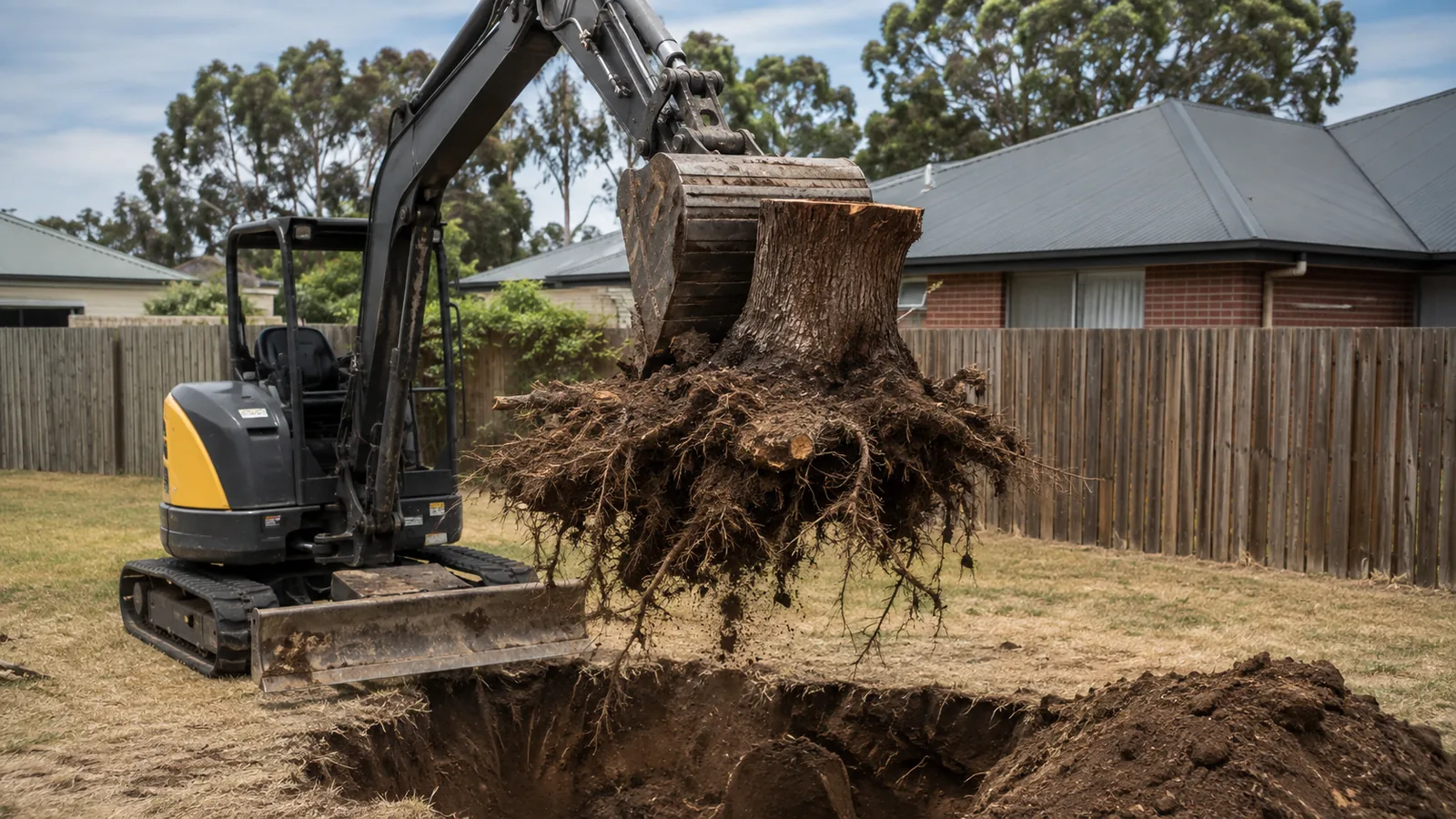
The physical difference. A grinder cuts the stump into chip from the top down to a set depth below grade and leaves the root plate and every lateral root where they are. An excavator digs the whole root ball out as one lump and carts it away. Grinding takes out roughly the top fifth of the timber that is actually in your soil. Excavation takes out effectively all of it.
Grinding against full excavation.
The same 500mm stump in a Pakenham backyard, compared on the things that actually differ, including the parts of an excavation that do not appear on the quote until afterwards.
| What you are comparing | Stump grinding | Full excavation |
|---|---|---|
| Typical price, 500mm stump | $280 to $480 | 2 to 4 times that, so roughly $700 to $1,600 |
| Time on site | 30 to 60 minutes | Half a day, sometimes a full day once backfill is counted |
| Timber left in the ground | Root plate and all lateral roots, decaying over 5 to 15 years | None, if the job is done properly |
| What the surface looks like after | A hollow of woodchip, raked back and mounded | An open hole to be filled and compacted in layers |
| Damage to the rest of the yard | Wheel marks from a 760mm machine, chip spread a couple of metres | Excavator access route, a spoil heap, usually lawn to reinstate |
| Turf over the spot? | Yes, ground to 150mm with grindings out and topsoil in | Yes, once the fill has been compacted properly |
| Concrete slab over the spot? | No | Yes, and this is the entire reason the method exists |
| When it is mandatory | Never mandatory, it is the default method | Slab, shed footing, extension, pool shell, wall footing, service trench |
The 2 to 4 times multiple is real, and it is not a markup. You are paying for a different machine, several times the hours, and the stump leaving the site as waste rather than staying on it as chip. Then there is fill. A 500mm stump with a decent root ball leaves a hole that can take half a cubic metre or more of clean fill to bring back to grade, and that fill has to go in and be compacted in 150 to 200mm layers, not tipped in loose. Both methods are priced out in full on the 2026 price guide.
Why grinding is the default answer.
A stump grinder is a wheel of carbide teeth that sweeps side to side and takes a few millimetres of timber per pass. It does not have to reach around the stump, it does not have to lift anything, and it barely disturbs the soil more than a metre out from the trunk. On an estate block in Officer or Cardinia Lakes that is the difference between a job that happens and a job that does not, because the alternative is getting a machine with a boom into a backyard that has a 760mm gate on it.
The trade-off is that the roots stay. That sounds worse than it is. Tree roots sit overwhelmingly in the top 300 to 600mm of soil and spread out one to three times the radius of the old canopy, so removing all of them was never on the table under either method. What an excavation really removes is the root plate, the dense mass directly under the stump. Grinding takes the top of that plate and leaves the remainder to break down, which under lawn or a garden bed causes nobody any trouble at all.
Grinding is also the only method that works where most residential stumps actually sit: a metre off a colorbond fence, hard against a brick wall, wedged between a rainwater tank and a meter box. Our narrow-access machine is 760mm wide, which clears the standard single side gate on nearly every newer block in the shire. What fits where is covered on narrow-access stump grinding, and the method itself is set out on how stump grinding works.
The void problem, which is the whole argument.
Timber left in the ground rots. Under lawn that is invisible and harmless. Under a concrete slab it is a slow structural fault. As the root plate breaks down across the following five to fifteen years, the volume it occupied becomes a void, the fill above it slumps into that void, and the slab loses its support over a patch that might be half a metre across. Concrete does not bridge that gap gracefully. It cracks, and the crack runs from the unsupported patch to the nearest edge.
The same logic applies to a shed footing, a fence post landing on an old root plate, a retaining wall footing, and paving laid on a rigid base. Anywhere the load path runs through the old stump position, the stump has to be physically gone. This is the one case where we tell a customer not to book the cheaper job, and it is set out in full on stump removal before a shed or extension.
Excavation has its own trap, and it is the crater. Digging a 600mm stump out can leave a hole a metre across and 600 to 800mm deep once the root ball is clear. That hole wants clean fill placed in layers and compacted as it goes. Tipped in loose it settles for a year or more, and you finish with the same sunken patch you were trying to avoid, having paid four times as much for it. If a quote for excavation says nothing about fill and compaction, ask before you accept it. What we include is on the full stump removal page.
Doing nothing, and when that is the right call.
No contractor puts this on their website, so here it is. A stump that is not in the way of anything does not have to come out. It breaks down on its own over five to fifteen years depending on species and soil, and while it does it holds moisture, feeds fungi and houses insects and skinks. On acreage at Nar Nar Goon or a treed block up at Pakenham Upper, leaving a paddock stump in a back corner is a sound decision and we will say so on the phone rather than quote you for it.
Four situations make leaving it the wrong call. It is in a lawn or across a path, where it is a trip hazard and it will eventually meet a mower. It sits inside the footprint of something you are building or landscaping, in which case the decision is already made. It is a suckering species, because poplar, some willows, robinia and a few wattles push new shoots from the root system whether the stump is there or not, and around Koo Wee Rup where willows and poplars line the old drains that is a weekly conversation. Or it is close to the house, where decaying timber near a slab edge raises the question dealt with on do old stumps attract termites.
Stump killer, and why it usually costs you a year.
The hardware store option is a stump killer, normally a concentrated glyphosate poured into freshly drilled holes, or a potassium nitrate powder sold as a decay accelerant. Both cost twenty to forty dollars. Both are far slower and far less certain than the packaging suggests.
Glyphosate needs living tissue to travel through. On a stump cut within the last day or two, with sap still moving, it can reach the root system and kill it, which is genuinely useful on a suckering poplar or willow and is the one job it does well. On a stump cut three months ago that has dried out, there is nothing left to carry it and the product does nothing whatsoever. Potassium nitrate does not kill anything; it feeds the fungi already breaking the timber down, so it can only speed up a process that is limited by moisture and warmth in the first place. On dense Australian hardwood, red gum, ironbark, sugar gum or old cypress, the honest expectation is one to three years, and often more.
The real problem is that the stump stays physically in the ground the whole time. You cannot turf over it, plant into it, pave across it or build on it. If the reason you want it gone is that you want the space, a chemical does not address the reason. If you are in no hurry at all and the stump is out of the way, you are back to the do nothing option above, which works about as well and costs nothing.
What to check before you book either job.
Measure across the widest part of the cut face at ground level, including the flared skirt where the trunk spreads into the soil. That flare is what you are paying to remove and it is where most people under-measure by 100mm or more. Then answer one question: what is going on that spot in the next five years. Lawn, a garden bed or a sand-set path all point to grinding, and the depth that job needs is worked through on how deep to grind a stump. A slab, a footing or a trench points to excavation.
Once the method is settled, the variables that move a grinding price are depth, whether surface roots need chasing, and whether the grindings stay or go. Those three are what separate a $280 quote from a $480 quote on the same stump, and they are unpacked on what stump grinding costs in Pakenham. If the answer is excavation, make sure fill and compaction are named in the price before you sign anything.
Grinding versus removal, answered.
What is the difference between stump grinding and stump removal?
Grinding cuts the stump into woodchip from the top down with a carbide wheel and leaves the root system in the ground to break down on its own. Full removal means digging the stump and its root ball out whole with an excavator, so nothing organic is left in the hole. Grinding is faster, cheaper and leaves the rest of the yard intact. Excavation costs two to four times as much, leaves a crater that has to be backfilled and compacted, and usually means machine tracks across your lawn. The two methods are not interchangeable. What is going on top of the spot is what decides which one is correct.
When do I actually need full excavation instead of grinding?
When something structural is going through the exact spot. A concrete slab, a shed footing, a house extension, a pool shell, a retaining wall footing or a service trench all need the root plate gone rather than ground off at the top. Grinding leaves the bulk of the root plate in the ground, that timber rots over five to fifteen years, and the space it occupied becomes a void. A void under a slab becomes a crack in the slab. If the spot is going back to lawn, garden bed or a sand-set path, grinding is the right method and excavation is money wasted.
How much more does full stump removal cost in Pakenham?
Two to four times the grinding price for the same stump, and that is before backfill. A 500mm stump that grinds out for $280 to $480 will typically be $700 to $1,600 to excavate, because you are paying for a second machine on site, the time to dig around and cut the root plate free, the stump leaving as waste, and then clean fill and compaction to bring the hole back to grade. The hole is the part people forget. A stump that size leaves a crater that swallows more imported fill than most people expect.
Do stump killer chemicals work instead of grinding?
Slowly and unreliably, and rarely worth it on established Australian hardwood. Products based on glyphosate or potassium nitrate are poured into drilled holes and work by killing living tissue or speeding up decay. On a stump cut in the last day or two, with sap still moving, glyphosate can reach the roots and does help. On a dry ironbark, red gum or old cypress stump it does close to nothing, because the timber is dense and the tree is already dead. Even when it works you wait one to three years, the stump is physically there the whole time, and you cannot build, turf or plant over it.
Is it ever fine to just leave a stump alone?
Yes, and it is worth saying out loud. A stump in the back corner of an acreage block, in a garden bed you are not replanting, or under a canopy where nobody walks is not hurting anything. It breaks down over five to fifteen years and in the meantime it is habitat. Four situations make doing nothing the wrong call: it is a trip hazard in a lawn or across a path, it sits inside the footprint of something you are building, it is a suckering species like poplar, willow or robinia that will keep pushing shoots, or it is close enough to the house that decaying timber becomes a termite question.
Tell us what is going on the spot and we will tell you which method.
Send the diameter at ground level, one photo from a few metres back, and what you plan to do with the ground afterwards. Pakenham, Officer, Beaconsfield, Nar Nar Goon, Pakenham Upper, Koo Wee Rup and the wider Cardinia Shire.