Stump grinding cost in Pakenham: how to read a quote.
The price bands are on the price guide. This page is about the part that costs people money: measuring the stump the way the contractor measures it, understanding what pushes a job above its band, and working out whether the cheap quote is a bargain or a different job with the same name on it.
Measure it the way we measure it.
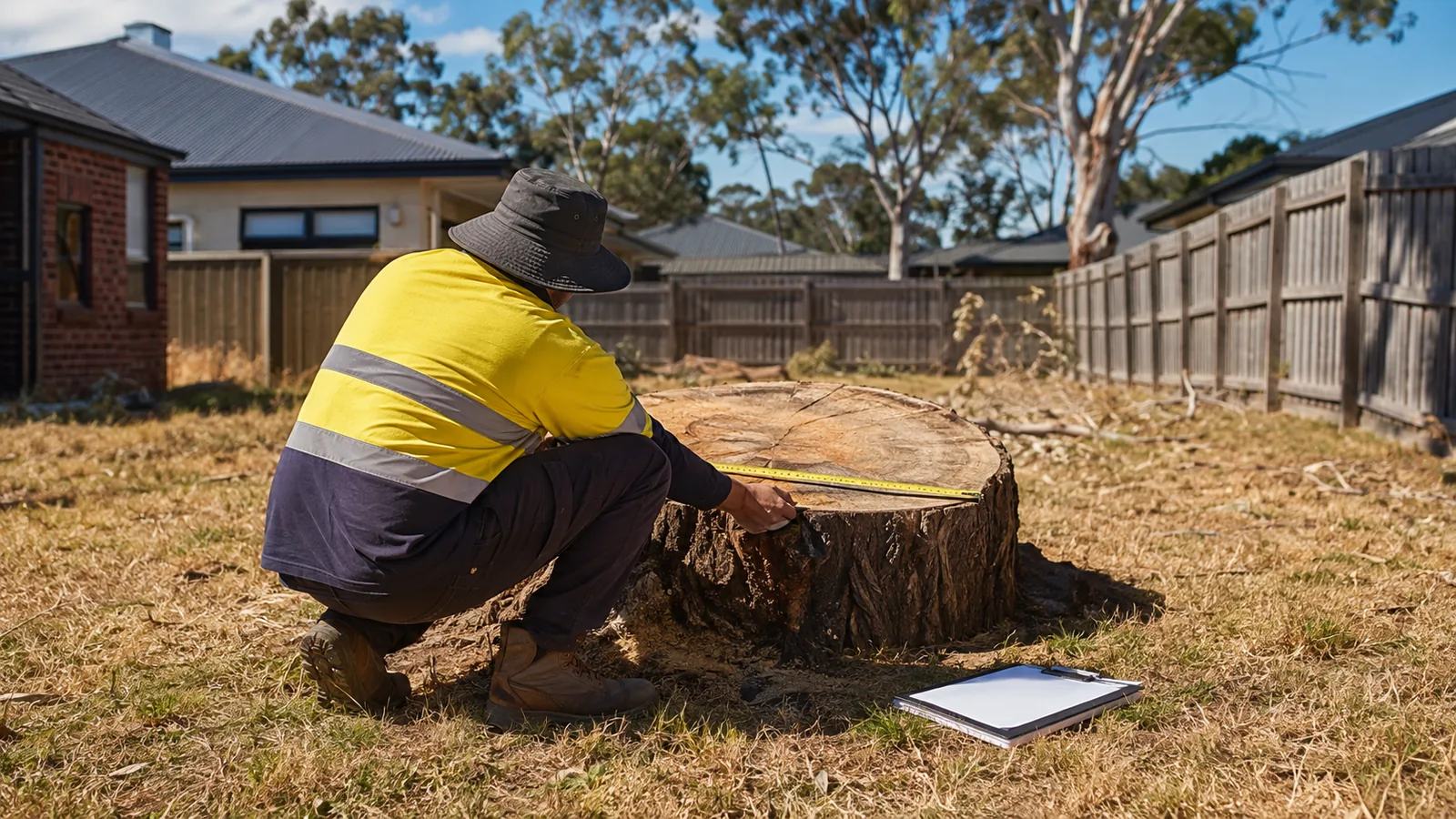
Stump grinding is priced off one measurement: the diameter of the cut face at ground level, taken at the widest point, including the root flare. Get that number right and every quote you receive will be within about twenty per cent of each other. Get it wrong and the quotes will look random, because each contractor is guessing at a different stump from your description.
The mistake is almost always the same one. People measure the tidy round part of the trunk, the bit that looks like a tree, and stop where it starts to flare out into the soil. The machine cannot stop there. That flared skirt is solid timber sitting in the ground, it is often the hardest and grittiest part of the whole stump because soil has washed into the crevices for years, and it has to come out along with everything else. On an established gum the flare can add 150mm to the diameter, which is enough to lift a job out of the $280 to $480 band and into the $450 to $800 one.
So run the tape along the ground, not around the trunk, and take it across the widest part of the base including the flare. Stumps are rarely round, so if yours is clearly oval, measure the wide way and the narrow way and send both. Add the height of the stump above ground if it is more than about 150mm, because anything left standing has to be cut down before the wheel can start, and add a note if soil or mulch has been mounded over the base, since there is usually more stump underneath than you can see.
The self-check. At $3.00 to $4.50 per centimetre of diameter, a stump you have measured at 45cm should be quoted somewhere near $135 to $200 of cutting, which the $180 to $250 minimum call-out lifts into the $280 to $480 band. If a quote lands far outside that, either your measurement is wrong or the quote covers something different. Both are worth a phone call.
Five things that make a stump cost more than its size suggests.
The diameter sets the starting point. These five decide whether the job lands at the bottom of its band or above the top of it, and all five are visible before anyone starts a machine.
1. Hard timber. Carbide teeth are a consumable. A red gum, ironbark, sugar gum or old cypress stump blunts a set several times faster than radiata pine, willow or a fruit tree, and blunt teeth cut slower, which means the job takes longer as well as costing more in steel. That is why the same 500mm diameter can be a comfortable $300 job in a Koo Wee Rup willow and an $480 job in a Nar Nar Goon paddock sugar gum. If you know what the tree was, say so when you ask for a price.
2. Grit in the bark and around the base. Soil is far harder on teeth than timber is. A stump in sandy or gravelly ground, one that has had garden soil or mulch mounded up around it for a few years, or one on a rocky slope, wears teeth on every pass. The old swamp country around Koo Wee Rup is abrasive sand over peat and it shows up in tooth wear; the basalt float and shallow topsoil up at Pakenham Upper is worse again, because a hidden rock at 200mm can stop a job dead.
3. One-sided access. A grinder works by sweeping across the stump, so an operator who can walk the machine right around it is working at full speed. A stump you can only attack from one side can take twice as long for the same volume of timber, because every pass has to be set up rather than swung through. This is the quiet reason a back-corner stump costs more than the identical stump in an open lawn.
4. Proximity to something that must not be touched. Hard against a brick wall, tight to a colorbond fence, a metre off a meter box, beside a retaining wall or over an irrigation line, and the job slows down. Screens have to go up, the wheel cannot be swung freely, and the last 50mm nearest the obstacle often has to be taken out by hand. Where services might be shallow, a Before You Dig Australia enquiry is free and worth lodging, and if the plans come back vague a private locator is $250 to $600.
5. Roots, which are a separate job. Surface roots running out under lawn, a path or a driveway are not part of a stump price and never have been. They are priced by the metre of root run, $60 to $150, because chasing a root means opening a trench along it. A quote that does not mention roots has not included them. Whether you need them done at all depends entirely on what is going over the top, which is covered on surface root removal.
Why the lowest number is often a different job.
Three quotes on the same stump can come back at $240, $380 and $460 without anybody being dishonest, because stump grinding has no standard specification. The word "grinding" covers a 100mm skim and a 300mm cut, and both are accurate descriptions.
Depth is the biggest gap. Taking a stump to 100mm below grade is perhaps a third of the wheel time of taking it to 300mm, because the stump gets wider as you go down and the flare and the top of the root plate are the densest material in the whole job. A contractor quoting 100mm is quoting a genuinely smaller job. That is fine if you are covering the spot with 400mm of garden bed. It is not fine if turf is going down, and it is useless if a paver base is going over the top. The depth each end use needs is set out on how deep to grind a stump.
After depth, the two usual gaps are roots and spoil. Roots are separate work at $60 to $150 per metre and a cheap quote will not have them. Spoil is free if the grindings stay on site and $120 to $350 if they are carted off, plus $80 to $220 if clean topsoil goes back in the hole. A quote that assumes the chip stays will always beat one that assumes it goes, and the customer who wanted turf down next weekend then pays the difference afterwards anyway.
There is one more case worth naming. Occasionally a very low quote is a genuine bargain, because the contractor is already working two streets away that morning and the travel is effectively free. If a price looks low and the answers to the four questions below all line up, take it.
Four questions, and what a good answer sounds like.
Ask every contractor the same four things and the numbers stop being random. The questions are short. The answers are what you are actually buying.
What depth is that price to? A good answer is a number in millimetres tied to what you told them you are doing with the spot, such as 150mm for turf or 300mm for paving. A poor answer is "as deep as it needs to be" or "below ground level", both of which mean the depth will be whatever is quick on the day.
Does it include the surface roots, or just the stump? A good answer names the roots either way: included for a stated number of metres, or excluded with a rate per metre if you want them. A poor answer treats roots as part of the stump, which they are not, and you will find out when the pavers lift.
Are the grindings staying or going? A good answer says raked back and mounded, or carted off with topsoil backfill at a stated price. A poor answer says the site will be left tidy, which is not the same thing and is not a specification.
Is it a fixed price or an hourly rate? A good answer on a residential stump is a fixed price, because nobody can see inside a stump and the contractor is better placed to carry that uncertainty than you are. Hourly is reasonable on acreage or a clearing job where scope genuinely cannot be pinned down, which is the case on much of the block clearing work we do out towards Nar Nar Goon and Koo Wee Rup.
The call-out minimum, and the cheapest money in the trade.
Every stump job carries a fixed cost before the wheel turns: driving to your address, unloading and reloading the machine, the underground services check, setting up debris screens, fuel, tooth wear and the trip home. That is the $180 to $250 minimum call-out, and it does not move with the size of the stump. It is why a 150mm stump and a 280mm stump often cost the same, and why a single small stump on its own is the worst value job in the trade.
The flip side is the best value job in the trade. Once the machine is on site and running, every additional stump carries only cutting time and steel, so it comes in 30 to 50 per cent under what it would cost as its own visit. Two 400mm stumps done together are not twice the price of one. Past about eight stumps the pricing stops being per-stump at all and moves onto a day rate of $1,400 to $2,600, which on a cleared block usually beats the per-stump total by a wide margin.
Practically: before you book, walk the block. The dead wattle behind the shed, the stump the previous owner left in the side yard, the fruit tree that came out two summers ago. Adding them to the same visit costs a fraction of getting them done next year, and it is the one piece of pricing advice on this site that reliably saves people hundreds of dollars. The full band table and the interactive estimator are on the 2026 price guide.
Deposits, invoices and how this trade normally works.
Residential stump work is quoted as a fixed price and paid on the day, by bank transfer or card, once you have seen the finished job. Deposits are unusual on work that takes under an hour, and a request for a large deposit up front on a single small stump is worth pausing over. Larger jobs behave differently: a multi-day clearing job on acreage may reasonably be staged, and a job that needs a private services locator or an excavator brought in will often ask for that cost up front, because it is paid to someone else before the work starts.
A written quote should name the address, the number of stumps and their diameters, the depth, whether roots and spoil are in or out, and a total. Ask for it in writing even on a $280 job, not because anything is likely to go wrong but because it is the document that makes the four questions above answered rather than discussed. If access is the uncertain part of your job, read backyard access and machine size before you get quotes, because a contractor who arrives to a gate the machine will not fit through has to charge for the trip either way. And if you are still choosing between grinding and excavation, the price difference is set out on grinding versus full removal.
Cost questions we get asked.
How do I measure a stump so my quote is accurate?
Put a tape across the cut face at ground level, at its widest point, and include the flare where the trunk spreads out into the soil. That flared skirt is timber the machine has to remove, so it is part of the number. Most people measure the neat round part of the trunk and miss 100mm or more of flare, which is enough to move a stump from one price band into the next and make every quote they receive look wrong. If the stump is not round, and few are, measure the widest way across and then the narrowest and give both figures.
Why is one quote hundreds of dollars cheaper than the others?
Usually because it is a quote for a different job. The most common difference is depth. A stump taken 100mm below grade is a fraction of the work of one taken to 300mm, and both can honestly be described as stump grinding. The next most common is roots, which are separate work priced by the metre and are simply not in a cheap quote. After that comes spoil, since leaving the grindings on site costs nothing and carting them off is $120 to $350. Ask what depth, roots in or out, and spoil staying or going, and the cheap quote either matches the others or explains itself.
What is the minimum call-out charge actually paying for?
The $180 to $250 minimum covers travel to your address, unloading and loading the machine, the underground services check, setting up debris screens, the fuel and the wear on the teeth, and the trip back. None of that changes with the size of the stump, which is why a 150mm stump and a 250mm stump often cost the same. It is also why a single small stump is poor value on its own and why a second stump on the same visit is 30 to 50 per cent cheaper. If you are near the minimum, look around the block before you book.
Why are extra stumps so much cheaper on the same visit?
Because the fixed costs are already paid. The travel, the unload, the services enquiry and the set-up all happen once regardless of how many stumps get ground, so every stump after the first only carries cutting time and tooth wear. That is typically 30 to 50 per cent less than the same stump would cost as its own visit. Past roughly eight stumps the pricing usually moves off per-stump entirely and onto a day rate of $1,400 to $2,600, which works out cheaper again. Doing a stump you were going to leave until next year is the easiest saving available in this trade.
Do stump grinders take a deposit or charge by the hour?
Residential stump work is normally quoted as a fixed price with no deposit and payment on the day the work is done, by transfer or card. Deposits are unusual on a job that takes under an hour, and being asked for a large one up front on a small stump is worth a second thought. Hourly rates do exist, mostly on acreage and clearing work where the scope genuinely cannot be pinned down in advance. On a single residential stump an hourly rate hands you the risk that the stump is bigger or harder underground than it looked, which is exactly the risk the contractor is better placed to carry.
Send the measurement and the end use, get a fixed number.
Diameter across the widest part of the cut face, one photo from a few metres back, and what is going on the spot afterwards. That is enough for a firm price on most residential stumps in Pakenham, Officer, Beaconsfield and the wider Cardinia Shire.