Tree roots lifting a driveway or paving.
The tree doing the damage is usually further away than people assume, the fix depends almost entirely on whether that tree is staying or going, and grinding a stump does nothing at all about roots that already ran out under your concrete. This page works through all three.
Shallow, and wider than the tree.
People picture a root system as a mirror image of the tree, going as deep as the canopy is tall. Actual root systems are shallow and wide. The overwhelming majority of a tree's roots sit in the top 300 to 600mm of soil, because that is where the oxygen and the water are, and they spread outwards well past the edge of the canopy, commonly one to three times the canopy radius.
Run those numbers on a real tree and the picture changes. A gum with a six metre canopy radius can have functioning roots twelve to eighteen metres from the trunk. That routinely means the tree lifting your driveway is not the one standing next to it. It can be in the neighbour's back yard, on the nature strip two houses along, or on the far side of your own house. The useful diagnostic is the shape of the damage, because a lifted section normally runs as a line rather than a patch, and that line points back along a single root towards whatever is feeding it.
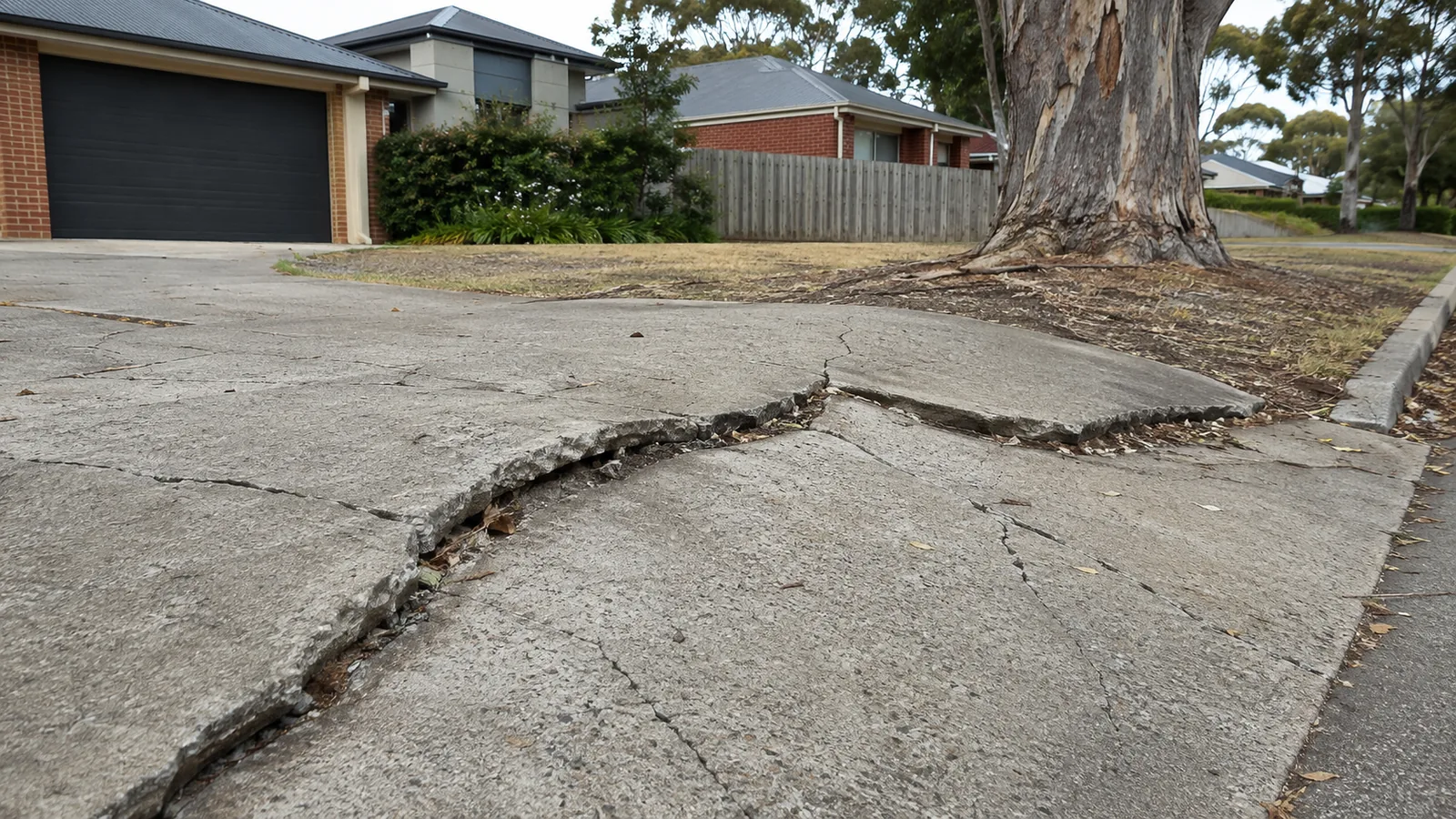
The other half of the explanation is why roots lift things at all. A root does not push forward against a slab and heave it up. It grows outwards along the easiest path, then thickens where it is, adding a new layer of wood every season. A root that slipped under the edge of a driveway when it was 20mm across becomes 120mm across over fifteen years, and something has to give. Concrete is strong in compression and weak in tension, so it cracks along the line and the sections tilt.
Hard surfaces also make attractive places for roots to be. The ground under a slab or a set of pavers stays cooler in summer, holds moisture that would otherwise evaporate, and offers a low-resistance path along the sand bedding or the interface between the slab and the subgrade. Roots follow that edge in preference to compacted soil, which is exactly why so much damage tracks along the perimeter of a driveway rather than crossing it randomly.
Concrete, pavers and kerbs fail differently.
What the surface is made of changes the symptom, the urgency and the repair, so it is worth naming which one you have before ringing anyone.
| Surface | What it looks like | What that means |
|---|---|---|
| Plain concrete driveway | A crack running roughly parallel to the boundary, with one side sitting proud of the other | The slab has failed in tension over a thickening root. The concrete does not go back down. Root work first, then a saw-cut and repour of the affected panel |
| Segmental pavers | A dome or a ridge of individual pavers standing 20 to 60mm above the rest, usually still intact | The best case. Pavers are laid on sand and can be lifted, the root dealt with, the bedding re-screeded and the same pavers reset |
| Path or crossover | A hump across the path, sometimes with a trip lip at a joint | A safety issue as much as an appearance one. Worth dealing with promptly where people walk, and worth photographing if it is on council land |
| Kerb and channel | Kerb pushed out of line, water ponding instead of running | Usually council infrastructure and usually a street tree. Report it rather than cutting roots on the nature strip yourself |
| Slab edge or garage floor | Cracking near an external edge or a lifted apron | Stop and get advice. Anything structural is a different conversation to a driveway panel |
One caution about nature strips and kerbs. Street trees and the kerb they sit behind are council assets in Cardinia Shire, and cutting roots on a council tree is not something a homeowner or a contractor should take on unasked. If the damage is on the road side of your boundary, report it to the shire and let them assess it.
Is the tree staying or going?
Every sensible root job starts here, and the two answers lead to completely different work.
If the tree is coming out, or is already gone and you have the stump left, the roots under your driveway are dead weight and can be cut back along the run without any consequence for the tree. That is ordinary surface root removal: expose the root, cut it cleanly at both ends of the affected section, remove the piece, and leave the ground rakeable. The spoil off a root chase behaves much like the material off a ground stump, so the same decisions apply to it, and those are set out in what to do with stump grindings. It is priced by the metre of root run rather than by the stump, at roughly $60 to $150 per metre in 2026, and the spread is wide because a root under open lawn is fast while the same root wedged between a concrete edge and a fence footing is slow and careful work.
If the tree is staying, cutting is a decision with real consequences and it needs to be made properly. Large structural roots close to the trunk are what hold a tree up. Sever several of them on one side and you can leave a mature tree that looks perfectly healthy standing on half an anchor, and the wind that finds that out is likely to arrive on the worst night of the year. That is an arborist's assessment, not a stump grinder's. The rough guidance the trade works to is to keep cuts as far from the trunk as the job allows, keep the cut diameter small, cut cleanly rather than tearing with an excavator bucket, and get anything significant on a large tree assessed first. Where the tree is protected under Cardinia Shire's Tree Protection Local Law, which covers living trees with a trunk circumference of 110cm or more measured at 1.4m above ground, and indigenous remnant species at any size, major root work may need permission as well.
Root barriers beat cutting the same root every five years.
Cutting a root on a living tree buys time and nothing more. The tree responds by regrowing, often with several new roots where there was one, and in five to ten years you are back where you started with a fresh lift in the same driveway. Householders who have owned a place for twenty years often describe doing exactly this two or three times.
The longer-term answer is a barrier: a rigid or geotextile panel installed vertically in a trench between the tree and the thing you are protecting, typically 600mm or deeper, sitting hard against the edge of the slab or the paving bedding. Roots that meet it are deflected down and along rather than under. Installed at the same time as the root cut and the surface repair, it turns a recurring problem into a job you do once. It costs more on the day because there is a trench and a product involved, and it is generally the right call where you are already paying to repair a driveway and the tree is staying put.
Barriers are also the sensible thing to install before a problem exists. If you are laying a new driveway, path or paved area within range of an established tree, putting a barrier in during construction costs a fraction of retrofitting one later, and the sequencing points are covered in stump grinding before turf or concrete.
Grinding the stump does nothing for a lifted driveway.
This is worth stating plainly because it costs people money every year. Somebody removes a tree that was lifting the concrete, has the stump ground, and expects the driveway problem to be solved. It is not. Grinding takes out the stump and the top of the root plate, generally 150 to 300mm below grade depending on end use. A root that already runs four metres out under the slab is completely untouched, and it stays in the ground breaking down over roughly five to fifteen years. Concrete that has already lifted does not settle back.
What fixes it is chasing the offending roots along their run, which is separate work with separate pricing, and then repairing the surface. If you are having a tree removed and you know the driveway is affected, get both quoted at the same time. And if a shed, a garage or an extension is going over the stump itself, grinding is the wrong method there too and the root plate needs excavating, which is set out in stump removal before a shed or extension. The machine is on site, the ground is already disturbed, and doing the root chase in the same visit is cheaper than bringing everything back. The difference between the two services is set out on the grinding page, and current rates for both are on the 2026 price guide.
One local note. Across the newer estates in Officer and the Pakenham growth corridor, developer-planted street trees and the fifteen year old gums in back yards are hitting the size where roots start to reach driveways and crossovers on 350 to 500 square metre blocks. The heavily reworked clay on those estates, often with imported fill over it, tends to push roots even more firmly into the top layer, because there is little reason for them to go down. That combination is why so many of these calls now come from streets that were paddock in 2010.
What roots do and do not do to plumbing.
Roots do not seek out pipes and they do not bore through sound pipe. What they do is grow where conditions are good, and a pipe with a cracked section or a failed joint is leaking moisture and nutrient into the soil around it, which makes that spot a good place to be. A fine root finds the gap, gets in, and then does what roots do: thickens in place. Over a few seasons a hairline defect becomes a mass of root inside the pipe and a blockage you notice in the laundry.
The practical consequence is about diagnosis. Old vitrified clay drainage with mortared or rubber-ring joints is vulnerable, particularly where ground movement in Cardinia clay has worked the joints loose over decades. Modern PVC with solvent-welded joints is not, unless it was damaged during construction or a trench was poorly backfilled. If you have recurring blockages, the pipe defect is the thing that needs fixing, because taking the tree out leaves the failing joint exactly where it was and the next root along will find it. A plumber with a camera answers this in half an hour. Where a tree really is implicated and it is coming out, the comparison between grinding it and excavating it is on stump grinding versus full removal.
Questions about roots and hard surfaces.
Which tree is lifting my driveway?
Usually one further away than you expect. Roots sit mostly in the top 300 to 600mm of soil and spread well past the canopy line, commonly one to three times the canopy radius, so a gum with a six metre canopy radius can have working roots twelve to eighteen metres out. The tree lifting your driveway may be in the neighbour's yard, on the nature strip, or on the far side of the house. Follow the line of the crack rather than looking at the nearest trunk, because a lifted section normally runs along one root.
Can I just cut the roots that are lifting my concrete?
If the tree is being removed anyway, yes, and it is straightforward. If the tree is staying, cutting has consequences. Large structural roots near the trunk anchor the tree, and severing several on one side can leave a mature tree unstable in wind, which is a safety question rather than a gardening one. Keep cuts well away from the trunk, keep them small, cut cleanly, and have anything significant on a large tree assessed by an arborist. A stump grinder is not the right trade to make that call.
Will grinding the stump stop the roots lifting my driveway?
No, and it is the most common misunderstanding in stump work. Grinding removes the stump and the top of the root plate, generally 150 to 300mm below grade. A root already running four metres out under your driveway is untouched, and it stays in the ground breaking down over roughly five to fifteen years. The driveway does not un-lift. What you need is surface root chasing along the run of the offending roots, priced separately at around $60 to $150 per metre.
What does surface root removal cost in Pakenham?
Root chasing is priced by the metre of root run rather than per stump, at roughly $60 to $150 per metre in 2026. The range is wide because the work varies: an exposed root under lawn is quick, and the same root running under a concrete edge, between a fence footing and a service trench, or through heavy clay is slow and careful. Have the run measured before committing, since a ten metre chase and a two metre chase are very different invoices. Repairing the hard surface is separate concreting or paving work.
Do tree roots break sewer and stormwater pipes?
Roots do not bore through sound pipe. They exploit cracks, failed joints and porous old sections where moisture is already leaking, and once a fine root is in the gap it thickens and turns a small defect into a blockage or a break. On older clay pipe with mortared or rubber-ring joints that is common. On modern PVC with welded joints it is unusual unless the pipe was damaged during construction. With recurring blockages, fix the pipe defect, because removing the tree leaves the failing joint exactly where it was.
Send a photo of the lift and we will tell you what is causing it.
One photo along the line of the crack, one of the nearest trees, and a rough measurement of how far the damage runs. That is normally enough to say whether this is a root chase, a barrier job, or something to take to an arborist first.